

Roman Polanski – The Tenant (1976) Trelkovsky Paranoid Close-Up Publicity Photo
Limited Edition Photograph (learn more)
In stock
Roman Polanski fills the frame as Trelkovsky in this stark black-and-white close-up publicity photograph from The Tenant (1976), his sidelong gaze and tightly controlled expression conveying the unease surrounding the increasingly isolated character. Wrapped in a heavy overcoat over his shirt and patterned tie, Trelkovsky remains outwardly conventional, yet the exceptionally close framing concentrates attention on his guarded face and uncertain gaze. Almost every distracting element has been eliminated, creating a psychologically charged study of a man whose sense of identity and security is steadily beginning to fracture.
The photograph’s strength lies in how little it needs to show. Polanski is framed from the upper chest upward, with the substantial texture of his dark overcoat enclosing the lighter shirt and tie beneath. His head turns slightly away from the camera while his eyes shift to the side, producing an expression that suggests suspicion, apprehension and constant awareness of something beyond the frame. The softly rendered architectural background provides only minimal context, leaving Trelkovsky’s face as the unmistakable center of the composition.
This Roman Polanski Trelkovsky The Tenant 1976 photograph is especially effective because the character still appears physically ordinary. There is no visible violence, disguise or overtly surreal imagery. Instead, the tension comes from the contrast between respectable clothing and unmistakable emotional unease. Trelkovsky looks like an ordinary Parisian tenant while simultaneously appearing unable to relax within the world around him, a contradiction that lies at the heart of the film.
Directed by Roman Polanski from a screenplay written with Gérard Brach, The Tenant—released in France as Le Locataire—casts Polanski as Trelkovsky, a quiet man who rents a Paris apartment whose previous occupant, Simone Choule, attempted suicide. His initially mundane experience as a new tenant becomes increasingly disturbing as neighbors complain about noise, unfamiliar details accumulate and Trelkovsky begins to suspect that the building’s inhabitants are attempting to transform him psychologically into the woman who lived there before him.
Adapted from Roland Topor’s novel Le Locataire chimérique, the film stars Isabelle Adjani, Melvyn Douglas, Shelley Winters and Jo Van Fleet alongside Polanski. The cinematography was by Sven Nykvist, whose controlled visual treatment contributes to the film’s atmosphere of surveillance, confinement and uncertainty. Production design by Pierre Guffroy turns the apartment building into something more psychologically oppressive than an ordinary residence, with windows, courtyards, corridors and neighboring rooms repeatedly becoming sources of anxiety.
The Tenant is commonly regarded as the concluding film in Polanski’s informal Apartment Trilogy, following Repulsion and Rosemary’s Baby. All three films explore psychological destabilization within domestic spaces, but Trelkovsky’s crisis is particularly concerned with identity itself. As his paranoia intensifies, distinctions between observation, persecution and hallucination become increasingly difficult to separate.
That psychological instability is already present in this photograph without any need for explicit horror imagery. Polanski’s compressed posture, sidelong eyes and restrained mouth communicate a man who appears to be listening, watching and anticipating danger. The heavy coat almost seems to close around him, adding another layer of visual isolation to an already tightly cropped image.
For collectors of psychological horror and Roman Polanski photography, this close-up offers an unusually concentrated character study. Rather than illustrating one of the film’s more surreal episodes, it captures the underlying emotional condition from which those later events develop: Trelkovsky’s suspicion, loneliness and increasing inability to trust either his surroundings or his own perceptions.
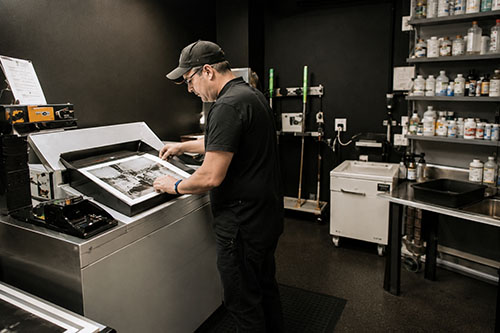
Carefully restored from historic photographic source material and professionally lab-developed, this museum-quality photograph is presented uncropped, preserving the complete image area contained in the source. Restoration recovers facial detail, eye definition, overcoat texture, patterned-tie detail and subtle background tonal separation while maintaining the natural tonal gradation and character of the historic black-and-white photograph. The finished photograph contains no AI-generated image content.
Product Enquiry
Kodak Professional Endura Paper
Kodak Endura papers provide an incredible amount of detail and smooth transition of tones. Designed for the professional photographer in mind, looking for a more traditional photo print style, Kodak Endura provides an extended print life and color gamut almost at the level of a high end fine art paper print.
Archival Matte Paper
Archival Matte Paper, also known as Moab Lasal Photo Matte, is our house stock fine art paper and is an economical favorite for fine art reproductions and photo prints. It features a smooth surface, heavy weight (230 g, 9.5-mil), neutral white, matte paper engineered for accurate color reproduction that provides high contrast and high-resolution output. This paper is acid-free, making it the perfect choice for both photography & fine art reproductions.
Giclee William Turner Paper by Hahnemühle
The William Turner by Hahnemühle is one of the most popular papers used in the Giclee printing industry. This is a 310g natural white mould made natural line paper with 100% rag content making it highly archival. It has a slight coarse texture which gives photos and artwork an elegant look. These fine art paper prints (also known as Giclee) are ordered by galleries, individual artists and photographers. The papers and inks are not only archival but use some of the most accurate print technology for full color prints.
- Giclee prints use very expensive archival pigmented inks.
- Highest level of color gamut available in printing (12 color printing).
- Exceptional black & white printing.
- Fade resistant, pigmented inks which provide a superior color range compared to other types of inks. Widely preferred in fine art and photography circles.
- We ONLY use professional grade fine art and photo paper that resist yellowing and aging.
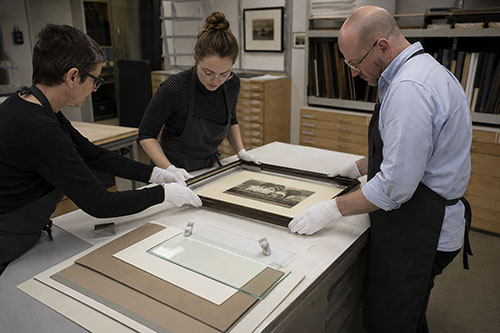
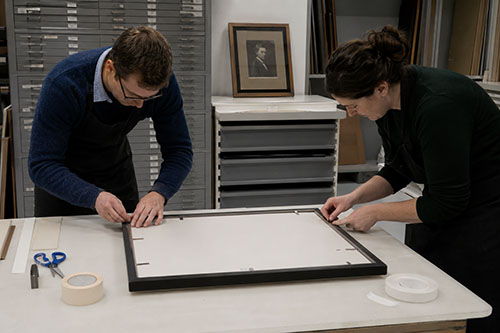
Framing
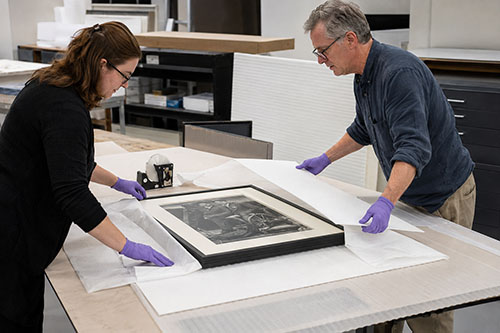
We offer wood and metal frames, custom cut & joined to order. Each framed print includes hanging hardware and foamcore backer.
Matting
We use conservation grade 100% virgin alpha-cellulose 2 ply mats with white core. Acid-free and lignin-free, these are both face resistant and meet all conservation quality standards set by the Fine Art Trade Guild. Mats are digitally cut for ultimate precision. The window will be 1/8″ smaller than the print dimensions.
Glazing (Acrylic Glass)
We offer custom cut panes of shatter-proof, acrylic glass, to protect your valuable artwork and prints.
Premium Clear
Framing grade clear acrylic is shatter resistant and lightweight.
Reflection Control
With its matte finish, Tru Vue Reflection Control® Acrylic scatters light to diminish unwanted glare.
Conservation Clear
Tru Vue Conservation Clear® Acrylic is a framing industry staple, blocking up to 99% of UV rays for ultimate protection.
Conservation Reflection Control
Tru Vue Conservation Reflection Control® Acrylic scatters and diffuses light to reduce unwanted glare. Blocks up to 99% of UV rays.
Related products
-

Sven Nykvist – The Tenant (1976) Oversized Apartment Set Forced Perspective Behind-the-Scenes Photo
$25.00 -
Fitzcarraldo (1982) – SS Molly Aida Steamship Hauled Over Mountain, Camisea Peru Production Photo
$25.00 -
Roman Polanski & Sven Nykvist – The Tenant (1976) Director’s Viewfinder Shot Framing Behind-the-Scenes Photo
$38.00 -
Roman Polanski – The Tenant (1976) Trelkovsky Jardin du Luxembourg Solitary Park Scene Photo
$25.00


