

Marie-France Pisier – Le Vampire de Düsseldorf (1965) Anna Dressing Room Boot-Lacing Crime Thriller Photo
Limited Edition Photograph (learn more)
In stock
MARIE-FRANCE PISIER appears as cabaret singer Anna in this wonderfully detailed black-and-white dressing-room photograph from Le Vampire de Düsseldorf (1965), seated while a man carefully fastens the laces of her tall stage boot. Pisier occupies the foreground in a ruffled performance costume, one leg raised toward him as she watches the preparation, while another woman stands behind her near the illuminated mirror. The dressing table is crowded with cosmetics, bottles and personal items; theatrical costumes hang nearby, makeup bulbs surround the mirror, and Anna’s dark hat rests beside her. Every part of the frame contributes to the backstage atmosphere, making the unusual boot-lacing action far more interesting than a conventional glamour pose. The photograph feels like a private moment of preparation before Anna returns to the cabaret rather than a formally arranged star portrait.
The close, crowded composition is especially effective. Pisier’s seated figure and extended leg create a strong diagonal through the frame, while the man concentrating on the boot provides a contrasting point of attention. Mirrors, fabric, cosmetics and costume details establish Anna’s working environment without requiring any dramatic action. For collectors searching for Marie-France Pisier Le Vampire de Düsseldorf 1965, this photograph offers a particularly evocative character image because it concentrates on Anna’s backstage world and the everyday ritual of preparing for a performance.
Directed by Robert Hossein, Le Vampire de Düsseldorf was a French-Italian-Spanish production inspired by the crimes of Peter Kürten, the German murderer historically known as the “Vampire of Düsseldorf.” Hossein also stars as Kürten and contributed to the screenplay with Claude Desailly, Georges Tabet and André Tabet, while Marie-France Pisier plays Anna, a cabaret singer who becomes central to his increasingly dangerous obsession. French heritage-cinema records confirm Pisier’s role, Alain Levent as director of photography, André Hossein as composer and Raymond Voinquel as production still photographer.
The story takes place in Düsseldorf during the early 1930s, as a series of murders creates fear throughout the city. Kürten lives an outwardly ordinary existence while pursuing Anna and entering the nightlife surrounding her cabaret performances. As their relationship develops, Anna eventually discovers the truth about him and becomes instrumental in bringing his crimes to the attention of the authorities. The film approaches this material as a psychological crime thriller and drama rather than supernatural vampire horror, using the historical nickname in its title while keeping the menace grounded in human behavior.
The production was photographed in stark black and white in 35mm Franscope, giving the film a wide-screen visual style particularly suited to its shadowed streets, cabaret interiors and tense psychological atmosphere. French archival records list the original French release on 7 April 1965 and identify the production companies as including Rome-Paris Films, Mega Film and Producciones Benito Perojo.
For collectors, this photograph has special appeal because it avoids the murderer and concentrates instead on Anna’s world. Pisier’s expression, costume and dressing-room surroundings provide a quieter counterpoint to the film’s darker subject matter, while the visible preparation of her footwear gives the image an unusually specific and memorable visual hook.
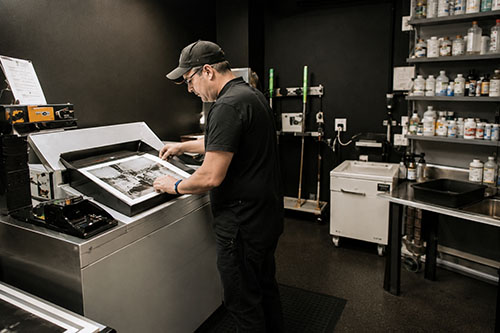
Carefully restored from historic photographic source material and professionally lab-developed, this museum-quality photograph is presented uncropped, preserving the complete image area contained in the source. Restoration recovers facial detail, costume fabric, boot lacing, cosmetics, illuminated mirror bulbs and subtle textures throughout the crowded dressing room while maintaining the natural tonal gradation and character of the historic black-and-white photograph. The finished photograph contains no AI-generated image content.
A fascinating character study of Marie-France Pisier as Anna, this image combines European crime cinema, backstage theatrical detail and the sophisticated black-and-white atmosphere of Le Vampire de Düsseldorf.
Product Enquiry
Kodak Professional Endura Paper
Kodak Endura papers provide an incredible amount of detail and smooth transition of tones. Designed for the professional photographer in mind, looking for a more traditional photo print style, Kodak Endura provides an extended print life and color gamut almost at the level of a high end fine art paper print.
Archival Matte Paper
Archival Matte Paper, also known as Moab Lasal Photo Matte, is our house stock fine art paper and is an economical favorite for fine art reproductions and photo prints. It features a smooth surface, heavy weight (230 g, 9.5-mil), neutral white, matte paper engineered for accurate color reproduction that provides high contrast and high-resolution output. This paper is acid-free, making it the perfect choice for both photography & fine art reproductions.
Giclee William Turner Paper by Hahnemühle
The William Turner by Hahnemühle is one of the most popular papers used in the Giclee printing industry. This is a 310g natural white mould made natural line paper with 100% rag content making it highly archival. It has a slight coarse texture which gives photos and artwork an elegant look. These fine art paper prints (also known as Giclee) are ordered by galleries, individual artists and photographers. The papers and inks are not only archival but use some of the most accurate print technology for full color prints.
- Giclee prints use very expensive archival pigmented inks.
- Highest level of color gamut available in printing (12 color printing).
- Exceptional black & white printing.
- Fade resistant, pigmented inks which provide a superior color range compared to other types of inks. Widely preferred in fine art and photography circles.
- We ONLY use professional grade fine art and photo paper that resist yellowing and aging.
Framing
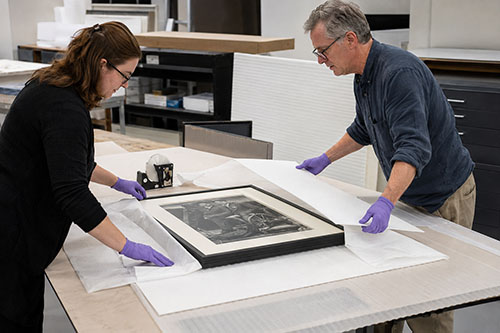
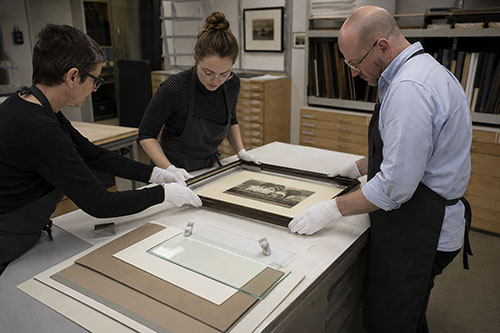
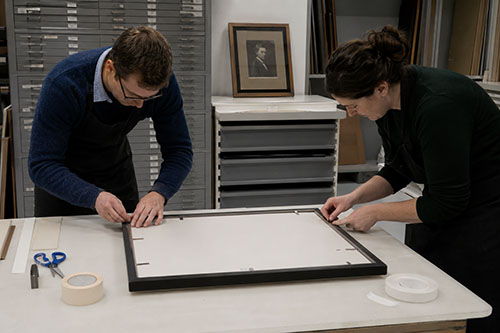
We offer wood and metal frames, custom cut & joined to order. Each framed print includes hanging hardware and foamcore backer.
Matting
We use conservation grade 100% virgin alpha-cellulose 2 ply mats with white core. Acid-free and lignin-free, these are both face resistant and meet all conservation quality standards set by the Fine Art Trade Guild. Mats are digitally cut for ultimate precision. The window will be 1/8″ smaller than the print dimensions.
Glazing (Acrylic Glass)
We offer custom cut panes of shatter-proof, acrylic glass, to protect your valuable artwork and prints.
Premium Clear
Framing grade clear acrylic is shatter resistant and lightweight.
Reflection Control
With its matte finish, Tru Vue Reflection Control® Acrylic scatters light to diminish unwanted glare.
Conservation Clear
Tru Vue Conservation Clear® Acrylic is a framing industry staple, blocking up to 99% of UV rays for ultimate protection.
Conservation Reflection Control
Tru Vue Conservation Reflection Control® Acrylic scatters and diffuses light to reduce unwanted glare. Blocks up to 99% of UV rays.
Related products
-

Boris Karloff – Frankenstein (1931) Monster Descending Stone Steps Film Still
$30.00 -
The Howling (1981) Werewolf Venetian Blind Shadows Rob Bottin Creature Photo
$25.00 -
Peter Cushing – The Curse of Frankenstein (1957) Baron Victor Frankenstein Top Hat Publicity Photo
$30.00 -
Fay Wray – King Kong (1933) Ann Darrow Glamour Close-Up Publicity Photo
$38.00


