

Peter Cushing – Torture Garden (1967) Lancelot Canning Poe Collector Close-Up Photo
Limited Edition Photograph (learn more)
In stock
Peter Cushing fills the frame as Lancelot Canning in this striking color close-up from “The Man Who Collected Poe,” the final story in Torture Garden (1967). Cushing’s piercing blue eyes, carefully controlled expression and almost direct gaze dominate the tightly composed photograph, creating an unusually intimate study of the obsessive collector whose extraordinary private archive conceals the segment’s macabre secret. With virtually nothing competing for attention, the image places Cushing’s face and Canning’s quietly intense personality entirely at its center.
The photograph is especially effective because of its remarkable restraint. Cushing is shown from the shoulders upward, dressed in a dark blue cardigan over a pale shirt with a patterned neck scarf or cravat tucked closely at the collar. His neatly combed hair, slightly raised brows and attentive expression suggest intelligence and refinement rather than overt menace. Behind him, framed objects and the subdued interior dissolve into soft focus, allowing his illuminated face to emerge clearly against the darker surroundings.
This Peter Cushing Torture Garden 1967 image captures exactly what makes Lancelot Canning such an effective character. He is not presented as a conventional horror villain, but as a cultivated, knowledgeable and intensely private collector whose passion for Edgar Allan Poe has become an obsession inherited across generations. The closeness of the camera emphasizes that cerebral quality: Canning appears composed and hospitable, yet Cushing’s fixed gaze gives the portrait a subtle unease that becomes increasingly meaningful as the story develops.
Directed by Freddie Francis for Amicus Productions and written by Robert Bloch, Torture Garden is an anthology horror film built around four macabre tales. The final segment, “The Man Who Collected Poe,” pairs Cushing’s Lancelot Canning with Jack Palance as Ronald Wyatt, another passionate Poe collector. Bloch adapted the segment from his own short story of the same title, turning the obsessive pursuit of rare literary material into a particularly appropriate horror story about the collector’s desire to possess something no one else can obtain.
Canning’s collection initially appears to consist of extraordinarily rare editions, letters and personal objects associated with Poe. Wyatt soon discovers, however, that the collection extends far beyond conventional memorabilia. Hidden below the house are apparently unpublished Poe manuscripts written on modern paper, a detail that forces Canning to reveal the astonishing history of his family’s obsession. His grandfather had obtained Poe’s remains and, through occult knowledge, reanimated the dead writer, allowing new stories to continue being produced long after Poe’s nineteenth-century death.
The revelation transforms Canning’s boast of possessing the ultimate Poe collection into one of the anthology’s darkest jokes. His family has not merely collected books, manuscripts and artifacts—they have attempted to possess Poe himself. Wyatt’s own collecting mania then drives him beyond caution, pushing the story toward murder, discovery and the final confrontation with the resurrected author.
For collectors of Peter Cushing and Amicus horror photography, this close-up has particular appeal because it strips away nearly all narrative spectacle and concentrates on performance. The blue eyes, slight tension around the mouth, formal costume and softly shadowed study interior create an exceptionally refined character image. It preserves Cushing not in a moment of physical horror, but as the cultivated guardian of one of British anthology cinema’s most extraordinary fictional collections.
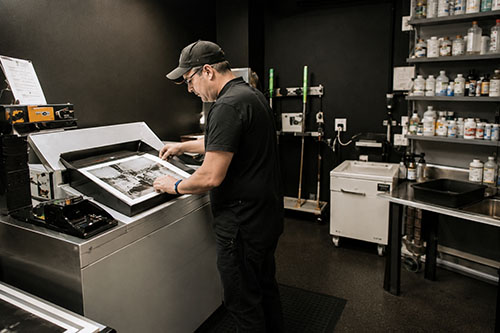
Carefully restored from historic photographic source material and professionally lab-developed, this museum-quality photograph is presented uncropped, preserving the complete image area contained in the source. Restoration recovers facial detail, blue-eye definition, skin tones, patterned neckwear, costume texture and subtle background shadow while maintaining the natural color balance and authentic character of the historic photograph. The finished photograph contains no AI-generated image content.
Product Enquiry
Kodak Professional Endura Paper
Kodak Endura papers provide an incredible amount of detail and smooth transition of tones. Designed for the professional photographer in mind, looking for a more traditional photo print style, Kodak Endura provides an extended print life and color gamut almost at the level of a high end fine art paper print.
Archival Matte Paper
Archival Matte Paper, also known as Moab Lasal Photo Matte, is our house stock fine art paper and is an economical favorite for fine art reproductions and photo prints. It features a smooth surface, heavy weight (230 g, 9.5-mil), neutral white, matte paper engineered for accurate color reproduction that provides high contrast and high-resolution output. This paper is acid-free, making it the perfect choice for both photography & fine art reproductions.
Giclee William Turner Paper by Hahnemühle
The William Turner by Hahnemühle is one of the most popular papers used in the Giclee printing industry. This is a 310g natural white mould made natural line paper with 100% rag content making it highly archival. It has a slight coarse texture which gives photos and artwork an elegant look. These fine art paper prints (also known as Giclee) are ordered by galleries, individual artists and photographers. The papers and inks are not only archival but use some of the most accurate print technology for full color prints.
- Giclee prints use very expensive archival pigmented inks.
- Highest level of color gamut available in printing (12 color printing).
- Exceptional black & white printing.
- Fade resistant, pigmented inks which provide a superior color range compared to other types of inks. Widely preferred in fine art and photography circles.
- We ONLY use professional grade fine art and photo paper that resist yellowing and aging.
Framing
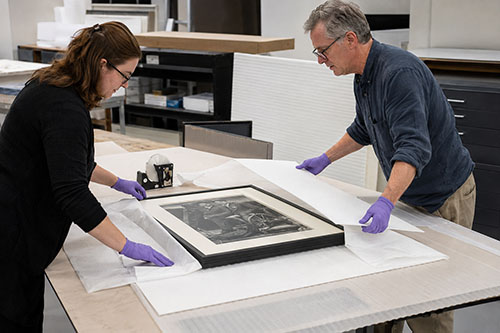
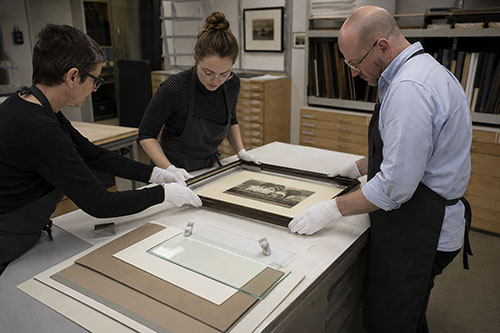
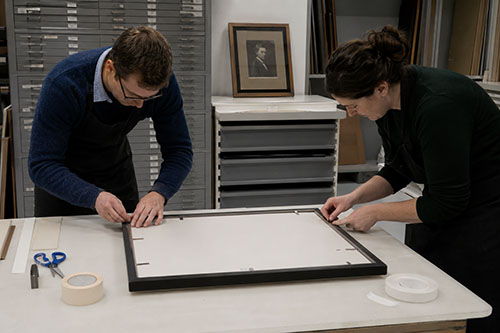
We offer wood and metal frames, custom cut & joined to order. Each framed print includes hanging hardware and foamcore backer.
Matting
We use conservation grade 100% virgin alpha-cellulose 2 ply mats with white core. Acid-free and lignin-free, these are both face resistant and meet all conservation quality standards set by the Fine Art Trade Guild. Mats are digitally cut for ultimate precision. The window will be 1/8″ smaller than the print dimensions.
Glazing (Acrylic Glass)
We offer custom cut panes of shatter-proof, acrylic glass, to protect your valuable artwork and prints.
Premium Clear
Framing grade clear acrylic is shatter resistant and lightweight.
Reflection Control
With its matte finish, Tru Vue Reflection Control® Acrylic scatters light to diminish unwanted glare.
Conservation Clear
Tru Vue Conservation Clear® Acrylic is a framing industry staple, blocking up to 99% of UV rays for ultimate protection.
Conservation Reflection Control
Tru Vue Conservation Reflection Control® Acrylic scatters and diffuses light to reduce unwanted glare. Blocks up to 99% of UV rays.
Related products
-

Madeline Smith – Frankenstein and the Monster from Hell (1974) Sarah Color Publicity Photo
$25.00 -
Katya Wyeth & Damien Thomas – Twins of Evil (1971) Mircalla Vampire Bite Photo
$30.00 -
Klaus Kinski – Nosferatu the Vampyre (1979) Count Dracula Long Fingernails Close-Up Photo
$30.00 -
Yutte Stensgaard, Michael Johnson & Jimmy Sangster – Lust for a Vampire (1971) Mircalla & Richard Kiss Scene Behind-the-Scenes Photo
$38.00