

Peter Cushing & Veronica Carlson – Frankenstein Must Be Destroyed (1969) Holding Script at Elstree Studios Publicity Photo
Limited Edition Photograph (learn more)
In stock
PETER CUSHING and VERONICA CARLSON smile together while holding the script during production of Frankenstein Must Be Destroyed (1969) at Elstree Studios in this wonderfully relaxed black-and-white publicity photograph. Cushing remains dressed as Baron Victor Frankenstein in his period waistcoat, striped trousers, shirt and formal neckwear, while Carlson sits closely beside him in contemporary clothing. The open script rests between them, with both performers holding its pages as they look directly toward the camera. Their easy smiles and informal seated pose create a striking contrast with the increasingly threatening relationship between Frankenstein and Carlson’s Anna Spengler in the finished film. Rather than presenting a dramatic scene or conventional character portrait, the photograph captures two principal performers during the practical working environment of a Hammer production.
The script is the strongest image-specific detail. It immediately identifies the photograph with the filmmaking process and gives the composition a genuine production-era character. Cushing’s costume maintains the visual connection with Baron Frankenstein, while Carlson’s modern dress reminds the viewer that this is an off-camera publicity moment rather than a scene from the story. For collectors seeking Peter Cushing Veronica Carlson Frankenstein Must Be Destroyed 1969 material, the combination of both stars, Cushing in costume, the shared script and the Elstree production setting gives the photograph considerable appeal.
Directed by Terence Fisher for Hammer Film Productions, Frankenstein Must Be Destroyed stars Cushing as Baron Victor Frankenstein and Carlson as Anna Spengler, alongside Simon Ward as Karl Holst, Freddie Jones as Professor Richter, Thorley Walters as Inspector Frisch and Maxine Audley as Ella Brandt. The film was produced by Anthony Nelson Keys, photographed by Arthur Grant and scored by James Bernard, with production taking place at EMI-MGM Elstree Studios in early 1969.
The story presents one of Cushing’s darkest interpretations of Frankenstein. Living under an assumed identity, the Baron discovers that Anna and her fiancé Karl are involved in illegal activity and uses that knowledge to force them into assisting his latest experiment. His objective is to recover the scientific knowledge locked inside the damaged mind of former colleague Professor Brandt, leading Frankenstein into increasingly ruthless acts as he pursues his work without regard for those around him.
That severity makes this photograph particularly enjoyable. On screen, Anna is drawn unwillingly into Frankenstein’s plans and subjected to mounting fear and danger; here, Carlson and Cushing appear completely at ease together. Their smiles, close seating and shared attention to the script reveal the performers behind the roles and provide a human counterpoint to the film’s grim Gothic atmosphere.
Frankenstein Must Be Destroyed was the fifth Hammer Frankenstein film starring Peter Cushing as the Baron, continuing the character he had first played in The Curse of Frankenstein (1957). By 1969, Cushing’s Frankenstein had evolved into a colder, more obsessive figure, making this relaxed production photograph especially effective for collectors familiar with the progression of the Hammer series.
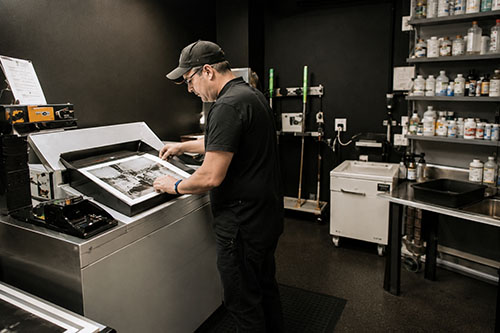
Carefully restored from historic photographic source material and professionally lab-developed, this museum-quality photograph is presented uncropped, preserving the complete image area contained in the source. Restoration recovers facial detail, hair texture, period clothing, script pages and subtle studio tonal detail while maintaining the natural tonal gradation and character of the historic black-and-white photograph. The finished photograph contains no AI-generated image content.
A charming and revealing Hammer production image, this photograph offers collectors an unusually relaxed view of Peter Cushing and Veronica Carlson holding the script during the making of one of the most uncompromising entries in Hammer’s Frankenstein series.
Product Enquiry
Kodak Professional Endura Paper
Kodak Endura papers provide an incredible amount of detail and smooth transition of tones. Designed for the professional photographer in mind, looking for a more traditional photo print style, Kodak Endura provides an extended print life and color gamut almost at the level of a high end fine art paper print.
Archival Matte Paper
Archival Matte Paper, also known as Moab Lasal Photo Matte, is our house stock fine art paper and is an economical favorite for fine art reproductions and photo prints. It features a smooth surface, heavy weight (230 g, 9.5-mil), neutral white, matte paper engineered for accurate color reproduction that provides high contrast and high-resolution output. This paper is acid-free, making it the perfect choice for both photography & fine art reproductions.
Giclee William Turner Paper by Hahnemühle
The William Turner by Hahnemühle is one of the most popular papers used in the Giclee printing industry. This is a 310g natural white mould made natural line paper with 100% rag content making it highly archival. It has a slight coarse texture which gives photos and artwork an elegant look. These fine art paper prints (also known as Giclee) are ordered by galleries, individual artists and photographers. The papers and inks are not only archival but use some of the most accurate print technology for full color prints.
- Giclee prints use very expensive archival pigmented inks.
- Highest level of color gamut available in printing (12 color printing).
- Exceptional black & white printing.
- Fade resistant, pigmented inks which provide a superior color range compared to other types of inks. Widely preferred in fine art and photography circles.
- We ONLY use professional grade fine art and photo paper that resist yellowing and aging.
Framing
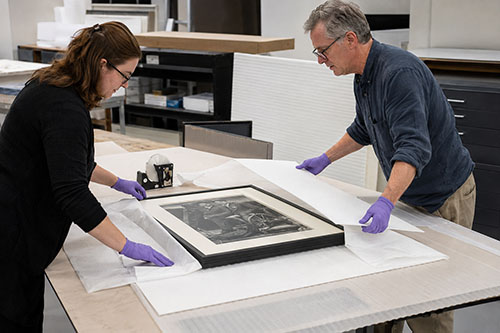
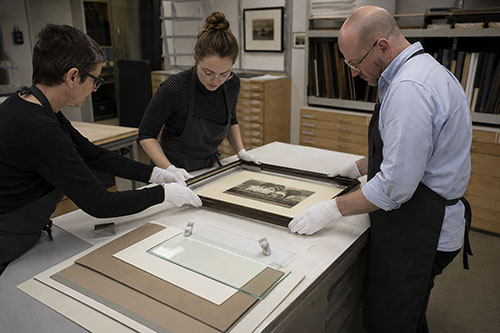
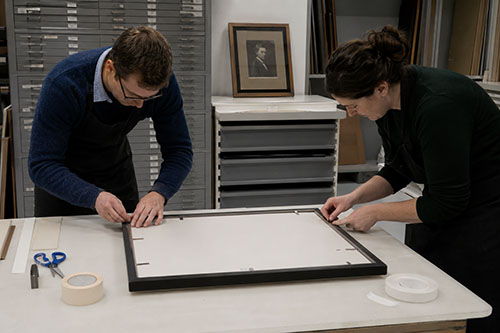
We offer wood and metal frames, custom cut & joined to order. Each framed print includes hanging hardware and foamcore backer.
Matting
We use conservation grade 100% virgin alpha-cellulose 2 ply mats with white core. Acid-free and lignin-free, these are both face resistant and meet all conservation quality standards set by the Fine Art Trade Guild. Mats are digitally cut for ultimate precision. The window will be 1/8″ smaller than the print dimensions.
Glazing (Acrylic Glass)
We offer custom cut panes of shatter-proof, acrylic glass, to protect your valuable artwork and prints.
Premium Clear
Framing grade clear acrylic is shatter resistant and lightweight.
Reflection Control
With its matte finish, Tru Vue Reflection Control® Acrylic scatters light to diminish unwanted glare.
Conservation Clear
Tru Vue Conservation Clear® Acrylic is a framing industry staple, blocking up to 99% of UV rays for ultimate protection.
Conservation Reflection Control
Tru Vue Conservation Reflection Control® Acrylic scatters and diffuses light to reduce unwanted glare. Blocks up to 99% of UV rays.
Related products
-

AKIKO WAKABAYASHI – YOU ONLY LIVE TWICE (1967) Aki Powder Blue Dress Doorway Publicity Photo
$38.00 -
Sean Connery & Luciana Paluzzi – Thunderball (1965) Fiona Volpe Bedroom Set Behind-the-Scenes James Bond 007 Photo
$38.00 -
Ingrid Pitt – Countess Dracula (1971) Countess Elisabeth Nádasdy Laughing in Costume Hammer Gothic Horror Photo
$38.00 -
CLINT EASTWOOD – DIRTY HARRY (1971) Panavision Camera Behind-the-Scenes Photo
$38.00