

Roman Polanski & Sven Nykvist – The Tenant (1976) Director’s Viewfinder Shot Framing Behind-the-Scenes Photo
Limited Edition Photograph (learn more)
In stock
Roman Polanski and cinematographer Sven Nykvist are captured during production of The Tenant (1976) in this exceptional black-and-white behind-the-scenes photograph, with Polanski raising a handheld director’s viewfinder to his eye as he studies the framing of a prospective shot. Nykvist stands immediately beside him while additional production personnel gather around a table covered with newspapers, papers and working materials. The informal surroundings and Polanski’s complete concentration on the optical finder create an unusually immediate record of director and cinematographer developing the visual construction of the film.
The photograph is particularly revealing because the handheld viewfinder places the act of composition directly at its center. A director’s optical viewfinder allows a filmmaker to preview framing and approximate the field of view of different lenses without first moving the full motion-picture camera into position. Here, Polanski is visibly evaluating the image while Nykvist observes beside him, preserving a practical stage in the transition from an idea for a shot to its eventual photographic execution.
Released in 1976, The Tenant was directed by Roman Polanski, who also portrays the central character Trelkovsky. Sven Nykvist served as director of photography, with Isabelle Adjani, Melvyn Douglas, Jo Van Fleet, Shelley Winters, Bernard Fresson and Lila Kedrova among the principal cast. AFI confirms Nykvist as cinematographer and Polanski as director and co-screenwriter.
The camera department included Jean Harnois as camera operator, with François Catonne and Bruno De Keyser as camera assistants and Bernard Prim as still photographer. These credits underline the larger photographic team working beneath Nykvist while Polanski maintained exceptionally close involvement with the film’s visual planning.
One later technical discussion featuring assistant cameraman François Catonné recalls Polanski’s preference for using a 29mm lens through much of the production. That moderately wide focal length could introduce subtle distortion at closer distances, reinforcing the uneasy visual character of Trelkovsky’s increasingly paranoid experience. The handheld viewfinder visible here would have been precisely the kind of tool useful for assessing how lens choice affected composition before the primary camera was repositioned.
That attention to framing was fundamental to The Tenant. The film repeatedly turns apparently ordinary apartments, windows, corridors and courtyards into psychologically threatening spaces. Nykvist’s restrained cinematography gives those environments a convincing physical reality, while Polanski gradually manipulates scale, viewpoint and spatial relationships until Trelkovsky’s surroundings seem inseparable from his deteriorating perception.
The production was also technically ambitious in its camera movement. La Cinémathèque française identifies The Tenant as the first feature film to employ the Louma crane, used for the celebrated extended opening movement through the apartment building. AFI likewise credits Louma for special photography. Together with the forced-perspective sets and carefully chosen lenses, such techniques demonstrate how extensively camera position and movement contributed to the film’s psychological design.
Polanski and Gérard Brach adapted the screenplay from Roland Topor’s novel Le Locataire chimérique. The story follows Trelkovsky, a solitary man who rents a Paris apartment formerly occupied by a woman who attempted suicide and gradually becomes consumed by paranoia, distorted perception and a terrifying erosion of personal identity.
The film is frequently associated with Repulsion (1965) and Rosemary’s Baby (1968) as Polanski’s informal Apartment Trilogy, works in which enclosed urban spaces become intimately connected with isolation and psychological instability. In The Tenant, the relationship between character and physical environment becomes especially pronounced, making the visual decisions documented in photographs such as this central to understanding how the film achieves its unsettling effect.
For collectors interested in cinematography and filmmaking technique, this image offers considerably more than a conventional production portrait. Polanski is shown actively looking through the viewfinder rather than merely posing beside the equipment, while Nykvist’s position at his shoulder captures the close relationship between directorial conception and photographic execution.
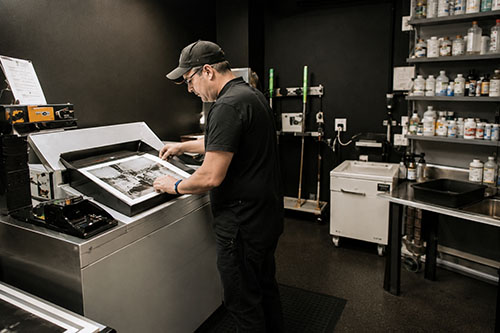
Carefully restored from historic photographic source material and professionally lab-developed, this museum-quality photograph is presented uncropped, preserving the complete image area contained in the source. Meticulous restoration recovers facial detail, viewfinder definition, clothing texture, tabletop materials, tonal range and photographic clarity while retaining the documentary character of the original black-and-white behind-the-scenes photograph.
For collectors of Roman Polanski, Sven Nykvist, The Tenant and motion-picture production history, this is an exceptional technical image—Polanski studying a shot through his director’s viewfinder while Nykvist watches beside him, preserving a rare and intimate record of two filmmakers shaping the visual language of one of the defining psychological films of the 1970s.
Product Enquiry
Kodak Professional Endura Paper
Kodak Endura papers provide an incredible amount of detail and smooth transition of tones. Designed for the professional photographer in mind, looking for a more traditional photo print style, Kodak Endura provides an extended print life and color gamut almost at the level of a high end fine art paper print.
Archival Matte Paper
Archival Matte Paper, also known as Moab Lasal Photo Matte, is our house stock fine art paper and is an economical favorite for fine art reproductions and photo prints. It features a smooth surface, heavy weight (230 g, 9.5-mil), neutral white, matte paper engineered for accurate color reproduction that provides high contrast and high-resolution output. This paper is acid-free, making it the perfect choice for both photography & fine art reproductions.
Giclee William Turner Paper by Hahnemühle
The William Turner by Hahnemühle is one of the most popular papers used in the Giclee printing industry. This is a 310g natural white mould made natural line paper with 100% rag content making it highly archival. It has a slight coarse texture which gives photos and artwork an elegant look. These fine art paper prints (also known as Giclee) are ordered by galleries, individual artists and photographers. The papers and inks are not only archival but use some of the most accurate print technology for full color prints.
- Giclee prints use very expensive archival pigmented inks.
- Highest level of color gamut available in printing (12 color printing).
- Exceptional black & white printing.
- Fade resistant, pigmented inks which provide a superior color range compared to other types of inks. Widely preferred in fine art and photography circles.
- We ONLY use professional grade fine art and photo paper that resist yellowing and aging.
Framing
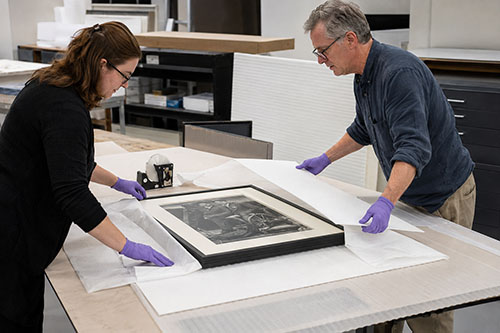
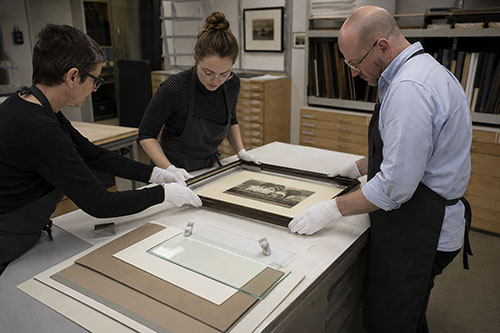
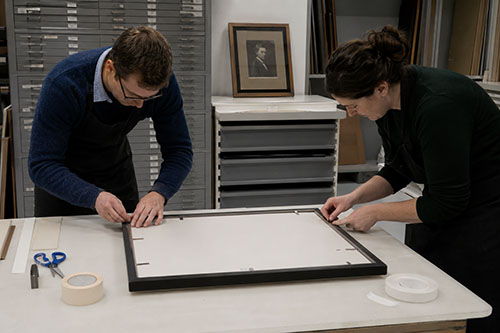
We offer wood and metal frames, custom cut & joined to order. Each framed print includes hanging hardware and foamcore backer.
Matting
We use conservation grade 100% virgin alpha-cellulose 2 ply mats with white core. Acid-free and lignin-free, these are both face resistant and meet all conservation quality standards set by the Fine Art Trade Guild. Mats are digitally cut for ultimate precision. The window will be 1/8″ smaller than the print dimensions.
Glazing (Acrylic Glass)
We offer custom cut panes of shatter-proof, acrylic glass, to protect your valuable artwork and prints.
Premium Clear
Framing grade clear acrylic is shatter resistant and lightweight.
Reflection Control
With its matte finish, Tru Vue Reflection Control® Acrylic scatters light to diminish unwanted glare.
Conservation Clear
Tru Vue Conservation Clear® Acrylic is a framing industry staple, blocking up to 99% of UV rays for ultimate protection.
Conservation Reflection Control
Tru Vue Conservation Reflection Control® Acrylic scatters and diffuses light to reduce unwanted glare. Blocks up to 99% of UV rays.
Related products
-

Ursula Andress – Dr. No (1962) Relaxing in Bikini on Jamaica Location Behind-the-Scenes Photo
$38.00 -
Colin Clive, Boris Karloff & Dwight Frye – Frankenstein (1931) Monster Creation Laboratory Wide View
$38.00 -
Sean Connery & Ursula Andress – Dr. No (1962) Crab Key Water Scene Jamaica Behind-the-Scenes Photo
$38.00 -
Yutte Stensgaard & Michael Johnson – Lust for a Vampire (1971) Mircalla & Richard Outdoor Embrace Photo
$38.00