

Sean Connery & Tetsuro Tamba – You Only Live Twice (1967) James Bond & Tiger Tanaka Camera Lens Behind-the-Scenes Photo
Limited Edition Photograph (learn more)
In stock
Sean Connery and Tetsuro Tamba are captured during production of You Only Live Twice (1967) in this wonderfully candid black-and-white behind-the-scenes photograph, with Connery seated in the foreground examining a substantial piece of camera equipment while Tamba sits immediately behind him in costume as Tiger Tanaka. Connery’s loosened tie, open-collar shirt and complete concentration on the optical equipment create an unusually informal view of the actor away from the polished image of James Bond, while the surrounding production personnel give the photograph the spontaneous atmosphere of a working film location.
The image is particularly engaging because Connery appears genuinely absorbed in the filmmaking equipment rather than acknowledging the still photographer. He turns the large optical component in his hands as though studying its construction or operation, while Tamba watches from behind amid crew members dressed for the Japanese location work. The result is a revealing production photograph in which James Bond’s leading man becomes temporarily fascinated by the machinery used to photograph him.
Released in 1967, You Only Live Twice was directed by Lewis Gilbert and produced by Albert R. Broccoli and Harry Saltzman for EON Productions. Sean Connery returned as James Bond 007, with Tetsuro Tamba as Tiger Tanaka, Akiko Wakabayashi as Aki, Mie Hama as Kissy Suzuki, Karin Dor as Helga Brandt and Donald Pleasence as Ernst Stavro Blofeld.
Tiger Tanaka is the head of the Japanese Secret Service and one of Bond’s most important allies in the film. Tanaka provides Bond with intelligence, protection and training as the investigation into the disappearance of American and Soviet spacecraft leads toward SPECTRE’s secret installation. He ultimately joins Bond, Kissy Suzuki and a force of ninja agents in the assault on Blofeld’s hidden volcano base.
The relationship between Bond and Tanaka gives Connery and Tamba substantial screen time together, making this informal production image particularly attractive to collectors. Away from the finished action, the photograph presents the two actors amid the everyday technical activity of filmmaking, preserving a much more relaxed interaction with the production environment than audiences see in the completed picture.
You Only Live Twice was photographed by Academy Award-winning cinematographer Freddie Young, with Bob Huke handling second-unit photography, John Jordan aerial photography and Lamar Boren underwater photography. AFI also credits legendary production designer Ken Adam, whose enormous volcano interior became one of the most celebrated sets in James Bond history.
Japan was fundamental to the film’s visual identity. Official Bond records list extensive production in Japan, alongside Pinewood Studios and additional international locations, while AFI documents filming in Tokyo and Kobe with a large British and international crew. The Japanese landscapes, architecture, transportation and cultural settings gave the fifth EON Bond film a visual character dramatically different from its predecessors.
The production was also one of the most ambitious Bond undertakings of the 1960s. Ken Adam’s volcano base became a spectacular centerpiece for the finale, accommodating Blofeld’s rocket installation, monorail and the large-scale ninja assault. Official 007 production history notes that the volcano set cost more than the entire budget of Dr. No, illustrating how dramatically the scale of the Bond series had expanded by 1967.
For Sean Connery, You Only Live Twice was his fifth EON appearance as James Bond. His relaxed presence in this photograph offers an appealing contrast with the controlled sophistication of Agent 007, showing Connery between takes surrounded by production personnel and apparently fascinated by the photographic equipment responsible for creating the film’s widescreen imagery.
For Tetsuro Tamba, Tiger Tanaka became his best-known international role. The official Bond archive describes Tanaka as the professional and resourceful head of the Japanese Secret Service, whose alliance with Bond becomes essential to defeating Blofeld’s plan. Tamba’s presence immediately behind Connery gives this behind-the-scenes image an especially strong connection to one of the film’s central partnerships.
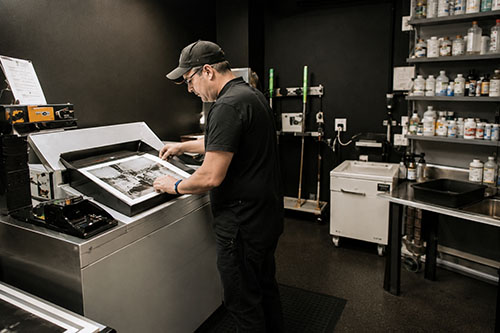
Carefully restored from historic photographic source material and professionally lab-developed, this museum-quality photograph is presented uncropped, preserving the complete image area contained in the source. Meticulous restoration recovers facial detail, optical-equipment definition, clothing texture, background personnel, tonal range and photographic clarity while retaining the spontaneous documentary quality of the original black-and-white behind-the-scenes photograph.
For collectors of Sean Connery, Tetsuro Tamba, You Only Live Twice and James Bond 007, this is an especially engaging production photograph—Connery examining camera equipment while Tamba sits directly behind him as Tiger Tanaka, preserving an unusually candid glimpse behind the filmmaking machinery of one of the most visually ambitious Bond adventures of the 1960s
Product Enquiry
Kodak Professional Endura Paper
Kodak Endura papers provide an incredible amount of detail and smooth transition of tones. Designed for the professional photographer in mind, looking for a more traditional photo print style, Kodak Endura provides an extended print life and color gamut almost at the level of a high end fine art paper print.
Archival Matte Paper
Archival Matte Paper, also known as Moab Lasal Photo Matte, is our house stock fine art paper and is an economical favorite for fine art reproductions and photo prints. It features a smooth surface, heavy weight (230 g, 9.5-mil), neutral white, matte paper engineered for accurate color reproduction that provides high contrast and high-resolution output. This paper is acid-free, making it the perfect choice for both photography & fine art reproductions.
Giclee William Turner Paper by Hahnemühle
The William Turner by Hahnemühle is one of the most popular papers used in the Giclee printing industry. This is a 310g natural white mould made natural line paper with 100% rag content making it highly archival. It has a slight coarse texture which gives photos and artwork an elegant look. These fine art paper prints (also known as Giclee) are ordered by galleries, individual artists and photographers. The papers and inks are not only archival but use some of the most accurate print technology for full color prints.
- Giclee prints use very expensive archival pigmented inks.
- Highest level of color gamut available in printing (12 color printing).
- Exceptional black & white printing.
- Fade resistant, pigmented inks which provide a superior color range compared to other types of inks. Widely preferred in fine art and photography circles.
- We ONLY use professional grade fine art and photo paper that resist yellowing and aging.
Framing
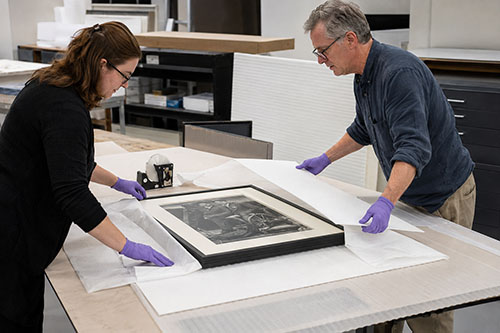
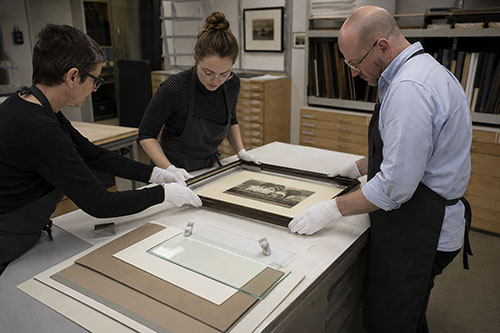
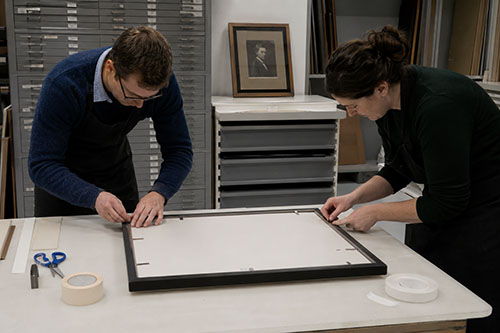
We offer wood and metal frames, custom cut & joined to order. Each framed print includes hanging hardware and foamcore backer.
Matting
We use conservation grade 100% virgin alpha-cellulose 2 ply mats with white core. Acid-free and lignin-free, these are both face resistant and meet all conservation quality standards set by the Fine Art Trade Guild. Mats are digitally cut for ultimate precision. The window will be 1/8″ smaller than the print dimensions.
Glazing (Acrylic Glass)
We offer custom cut panes of shatter-proof, acrylic glass, to protect your valuable artwork and prints.
Premium Clear
Framing grade clear acrylic is shatter resistant and lightweight.
Reflection Control
With its matte finish, Tru Vue Reflection Control® Acrylic scatters light to diminish unwanted glare.
Conservation Clear
Tru Vue Conservation Clear® Acrylic is a framing industry staple, blocking up to 99% of UV rays for ultimate protection.
Conservation Reflection Control
Tru Vue Conservation Reflection Control® Acrylic scatters and diffuses light to reduce unwanted glare. Blocks up to 99% of UV rays.
Related products
-

Sean Connery & Zena Marshall James Bond & Miss Taro Bedroom Kiss 007 Photo
$25.00 -
Sean Connery – Thunderball (1965) Shirtless Nassau Beach Location Behind-the-Scenes James Bond 007 Photo
$38.00 -
Sean Connery – Dr. No (1962) “Bond, James Bond” Le Cercle Casino Photo
$38.00 -
Sean Connery & Ursula Andress – Dr. No (1962) Crab Key Water Scene Jamaica Behind-the-Scenes Photo
$38.00


