

Yutte Stensgaard, Michael Johnson & Jimmy Sangster – Lust for a Vampire (1971) Mircalla & Richard Kiss Scene Behind-the-Scenes Photo
Limited Edition Photograph (learn more)
In stock
YUTTE STENSGAARD as Mircalla and MICHAEL JOHNSON as Richard LeStrange embrace while director JIMMY SANGSTER observes at remarkably close range in this candid black-and-white behind-the-scenes photograph from Lust for a Vampire (1971). Stensgaard and Johnson remain physically engaged in the romantic action, their faces meeting in a kiss as Johnson holds her closely around the shoulders and waist. Stensgaard’s long blonde hair and pale period dress contrast sharply with Johnson’s dark formal costume, while Sangster stands immediately beside them watching the performance. Folding chairs, equipment and other production details remain visible in the background, making it unmistakably an on-set working photograph rather than a completed scene still. Bringing Mircalla, Richard and the film’s director into the same frame gives the image exceptional documentary character.
The photograph is especially revealing because it captures the process of directing an intimate scene. Sangster is positioned close enough to study the actors’ placement and interaction while Stensgaard and Johnson maintain the embrace, providing a direct visual record of performance being shaped for the camera. Nothing has been concealed to preserve the finished Gothic illusion; the surrounding location activity remains visible. For collectors searching for Yutte Stensgaard Michael Johnson Lust for a Vampire 1971 photography, the combination of both romantic leads and their director at work gives this image considerably more production value than a conventional kiss still.
Directed by Jimmy Sangster from Tudor Gates’s screenplay, Lust for a Vampire stars Stensgaard as Mircalla, the resurrected Karnstein vampire, and Johnson as Richard LeStrange, a visiting writer who becomes captivated by her. Hammer’s own synopsis confirms Richard’s fascination with Mircalla and identifies Stensgaard, Johnson and Ralph Bates among the principal cast. The story is set in 1830, when the Karnstein family restores Mircalla to life and she enters a nearby finishing school, where attraction and suspicion quickly lead to further deaths.
The production forms the middle chapter of Hammer’s Karnstein cycle, following The Vampire Lovers and preceding Twins of Evil, with its characters derived from the vampire mythology created by Sheridan Le Fanu. Hammer production records confirm filming from 6 July to 18 August 1970, with studio work at Elstree Studios and the finishing-school exteriors photographed at Hunton Park, Abbots Langley, Hertfordshire. Director of photography David Muir photographed the feature in Technicolor.
Sangster’s presence in this photograph carries additional production-history significance. He had not originally been scheduled to direct the picture. Hammer records state that Terence Fisher was forced to withdraw after suffering a broken leg, leaving Sangster to take over directing duties shortly before production. Peter Cushing had similarly been intended for the role ultimately played by Ralph Bates but withdrew because of his wife’s illness. Seeing Sangster visibly working beside Stensgaard and Johnson therefore preserves a particularly tangible record of the director who stepped into the project under unusual circumstances.
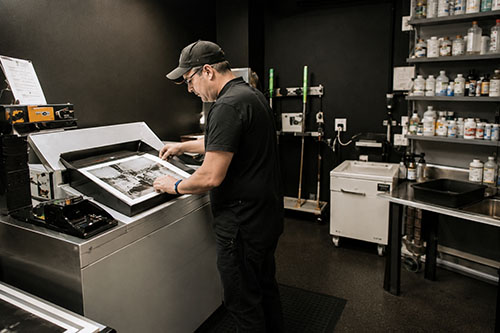
Carefully restored from historic photographic source material and professionally lab-developed, this museum-quality photograph is presented uncropped, preserving the complete image area contained in the source. Restoration recovers facial detail, hair texture, period costume fabric, foliage and production equipment while maintaining the natural tonal gradation and character of the historic black-and-white photograph. The finished photograph contains no AI-generated image content.
A fascinating Hammer production image, this photograph combines Yutte Stensgaard, Michael Johnson and Jimmy Sangster in a single candid view of the romantic scene and the filmmaking process behind it.
Product Enquiry
Kodak Professional Endura Paper
Kodak Endura papers provide an incredible amount of detail and smooth transition of tones. Designed for the professional photographer in mind, looking for a more traditional photo print style, Kodak Endura provides an extended print life and color gamut almost at the level of a high end fine art paper print.
Archival Matte Paper
Archival Matte Paper, also known as Moab Lasal Photo Matte, is our house stock fine art paper and is an economical favorite for fine art reproductions and photo prints. It features a smooth surface, heavy weight (230 g, 9.5-mil), neutral white, matte paper engineered for accurate color reproduction that provides high contrast and high-resolution output. This paper is acid-free, making it the perfect choice for both photography & fine art reproductions.
Giclee William Turner Paper by Hahnemühle
The William Turner by Hahnemühle is one of the most popular papers used in the Giclee printing industry. This is a 310g natural white mould made natural line paper with 100% rag content making it highly archival. It has a slight coarse texture which gives photos and artwork an elegant look. These fine art paper prints (also known as Giclee) are ordered by galleries, individual artists and photographers. The papers and inks are not only archival but use some of the most accurate print technology for full color prints.
- Giclee prints use very expensive archival pigmented inks.
- Highest level of color gamut available in printing (12 color printing).
- Exceptional black & white printing.
- Fade resistant, pigmented inks which provide a superior color range compared to other types of inks. Widely preferred in fine art and photography circles.
- We ONLY use professional grade fine art and photo paper that resist yellowing and aging.
Framing
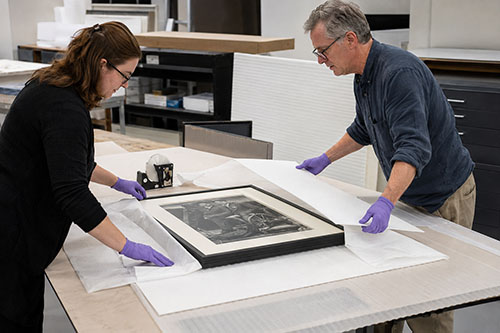
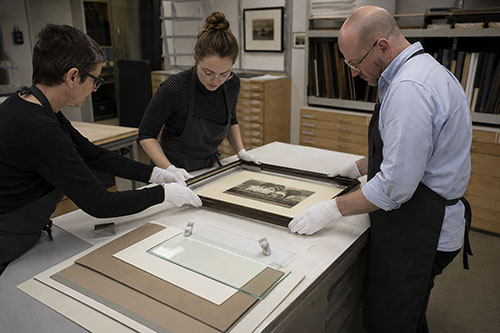
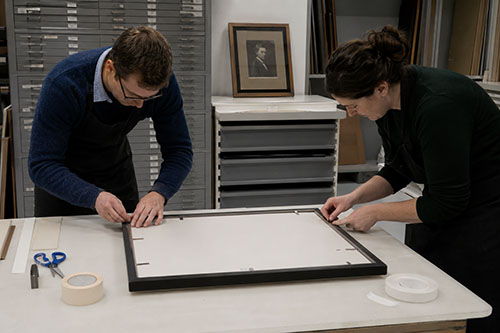
We offer wood and metal frames, custom cut & joined to order. Each framed print includes hanging hardware and foamcore backer.
Matting
We use conservation grade 100% virgin alpha-cellulose 2 ply mats with white core. Acid-free and lignin-free, these are both face resistant and meet all conservation quality standards set by the Fine Art Trade Guild. Mats are digitally cut for ultimate precision. The window will be 1/8″ smaller than the print dimensions.
Glazing (Acrylic Glass)
We offer custom cut panes of shatter-proof, acrylic glass, to protect your valuable artwork and prints.
Premium Clear
Framing grade clear acrylic is shatter resistant and lightweight.
Reflection Control
With its matte finish, Tru Vue Reflection Control® Acrylic scatters light to diminish unwanted glare.
Conservation Clear
Tru Vue Conservation Clear® Acrylic is a framing industry staple, blocking up to 99% of UV rays for ultimate protection.
Conservation Reflection Control
Tru Vue Conservation Reflection Control® Acrylic scatters and diffuses light to reduce unwanted glare. Blocks up to 99% of UV rays.
Related products
-

Sean Connery & Ursula Andress – Dr. No (1962) Torn-Shirt Finale Behind-the-Scenes Jamaica Photo
$30.00 -
Robert Hossein – Le Vampire de Düsseldorf (1965) Peter Kürten Night Street Crime Thriller Photo
$25.00 -
Ingrid Pitt – The Vampire Lovers (1970) Carmilla Ferocious Close-Up Photo
$30.00 -
Klaus Kinski & Isabelle Adjani – Nosferatu the Vampyre (1979) Dracula & Lucy Bedside Scene Photo
$38.00


