

YUTTE STENSGAARD & RALPH BATES – LUST FOR A VAMPIRE (1971) “Servant of the Devil” Giles Barton & Mircalla Hammer Horror Photo
Limited Edition Photograph (learn more)
In stock
Yutte Stensgaard as Mircalla confronts Ralph Bates as Giles Barton in one of the film’s most revealing occult encounters.
In Lust for a Vampire (1971), Barton’s scholarly fascination with the occult has led him to discover Mircalla’s true identity as Carmilla Karnstein. Rather than recoil from the revelation, he is drawn more deeply into her supernatural world. This atmospheric color image captures Bates in dark period dress facing Stensgaard in her flowing white nightgown, his raised hands and ritual-like gesture contrasting with Mircalla’s wary, almost detached response.
The photograph relates to Barton’s extraordinary declaration of devotion to Mircalla. Having concealed what he knows about her and disposed of the body of one of her victims, Barton begs to worship her and become her servant—explicitly describing himself as a “servant of the Devil.” The scene exposes the obsessive side of Bates’s character and leads directly toward Barton’s fatal encounter with the vampire he has chosen to serve.
Ralph Bates plays Giles Barton, a teacher fascinated by the occult, while Yutte Stensgaard portrays the resurrected Mircalla/Carmilla Karnstein. Hammer’s own synopsis describes Barton as yearning to become Mircalla’s disciple, while the film centers on the Karnsteins’ resurrection of Mircalla and her arrival at the nearby finishing school.
Directed by Jimmy Sangster from a screenplay by Tudor Gates, Lust for a Vampire was filmed from July 6 through August 18, 1970 and released in the UK on January 17, 1971. It forms the middle chapter of Hammer’s Karnstein cycle, following The Vampire Lovers (1970) and preceding Twins of Evil (1971), drawing on the vampire characters originating in Sheridan Le Fanu’s Carmilla.
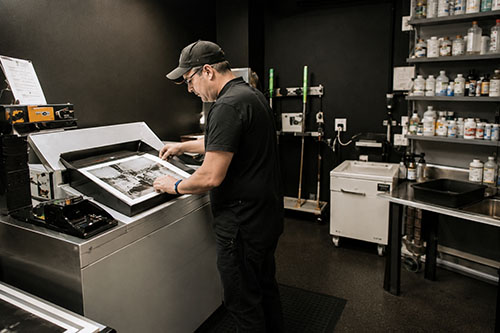
Carefully restored from archival source material and professionally lab-developed, this museum-quality photograph is presented uncropped, preserving the complete image area contained in the archival source material. Meticulous restoration recovers color balance, tonal detail, clarity, texture and photographic integrity while retaining the authentic character of the original production photograph.
For Hammer Horror collectors, this is an especially evocative image because it documents a key psychological dimension of the film: Barton is not merely a victim of the Karnsteins but a man actively fascinated by their evil. The pairing of Yutte Stensgaard’s Mircalla and Ralph Bates’s Giles Barton makes the photograph a compelling representation of the occult themes running beneath the film’s Gothic vampire story.
Product Enquiry
Kodak Professional Endura Paper
Kodak Endura papers provide an incredible amount of detail and smooth transition of tones. Designed for the professional photographer in mind, looking for a more traditional photo print style, Kodak Endura provides an extended print life and color gamut almost at the level of a high end fine art paper print.
Archival Matte Paper
Archival Matte Paper, also known as Moab Lasal Photo Matte, is our house stock fine art paper and is an economical favorite for fine art reproductions and photo prints. It features a smooth surface, heavy weight (230 g, 9.5-mil), neutral white, matte paper engineered for accurate color reproduction that provides high contrast and high-resolution output. This paper is acid-free, making it the perfect choice for both photography & fine art reproductions.
Giclee William Turner Paper by Hahnemühle
The William Turner by Hahnemühle is one of the most popular papers used in the Giclee printing industry. This is a 310g natural white mould made natural line paper with 100% rag content making it highly archival. It has a slight coarse texture which gives photos and artwork an elegant look. These fine art paper prints (also known as Giclee) are ordered by galleries, individual artists and photographers. The papers and inks are not only archival but use some of the most accurate print technology for full color prints.
- Giclee prints use very expensive archival pigmented inks.
- Highest level of color gamut available in printing (12 color printing).
- Exceptional black & white printing.
- Fade resistant, pigmented inks which provide a superior color range compared to other types of inks. Widely preferred in fine art and photography circles.
- We ONLY use professional grade fine art and photo paper that resist yellowing and aging.
Framing
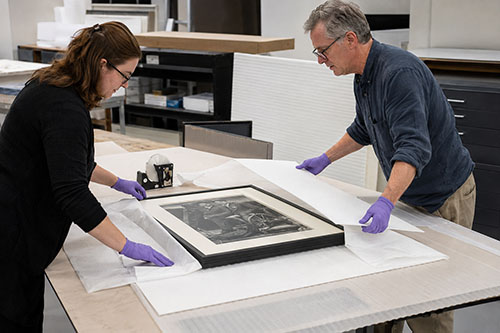
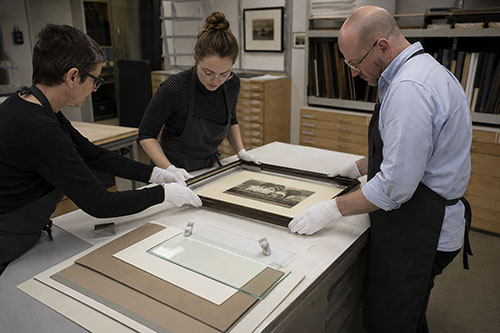
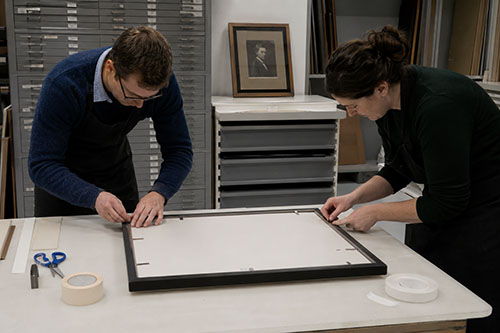
We offer wood and metal frames, custom cut & joined to order. Each framed print includes hanging hardware and foamcore backer.
Matting
We use conservation grade 100% virgin alpha-cellulose 2 ply mats with white core. Acid-free and lignin-free, these are both face resistant and meet all conservation quality standards set by the Fine Art Trade Guild. Mats are digitally cut for ultimate precision. The window will be 1/8″ smaller than the print dimensions.
Glazing (Acrylic Glass)
We offer custom cut panes of shatter-proof, acrylic glass, to protect your valuable artwork and prints.
Premium Clear
Framing grade clear acrylic is shatter resistant and lightweight.
Reflection Control
With its matte finish, Tru Vue Reflection Control® Acrylic scatters light to diminish unwanted glare.
Conservation Clear
Tru Vue Conservation Clear® Acrylic is a framing industry staple, blocking up to 99% of UV rays for ultimate protection.
Conservation Reflection Control
Tru Vue Conservation Reflection Control® Acrylic scatters and diffuses light to reduce unwanted glare. Blocks up to 99% of UV rays.
Related products
-

YUTTE STENSGAARD, MICHAEL JOHNSON & JIMMY SANGSTER – LUST FOR A VAMPIRE (1971) Kiss Scene Behind-the-Scenes Photo
$38.00 -
YUTTE STENSGAARD & JIMMY SANGSTER – LUST FOR A VAMPIRE (1971) Behind-the-Scenes Graveyard Filming Hammer Horror Photo
$30.00 -
YUTTE STENSGAARD – Lust for a Vampire (1971) Mircalla in White Nightgown, Graveyard Hammer Horror Photo
$25.00 -
LUST FOR A VAMPIRE (1971) Yutte Stensgaard Hammer Horror Original Belgian Theatrical Design 15×22 Fine Art Poster
$149.85