

Boris Karloff & Colin Clive – Frankenstein (1931) Monster & Creator Torch Confrontation Universal Horror Photo
Limited Edition Photograph (learn more)
In stock
BORIS KARLOFF and COLIN CLIVE face one another across a bleak, rocky rise in this striking black-and-white photograph associated with Frankenstein (1931). Clive, as Henry Frankenstein, stands at left gripping a burning torch, while Karloff’s Monster confronts him from the opposite side of the frame. The two figures are isolated against a dark, smoke-filled background, with rough earth and jagged rock forming an almost stage-like arena between them. The torch is the dominant point of light: its small, fierce flame cuts through the surrounding darkness and visually separates creator from creation. Karloff’s rigid stance and unmistakable Monster makeup contrast with Clive’s forward movement, giving the photograph a tense, suspended quality even before the viewer knows the outcome of their encounter.
The composition is especially effective because it reduces the conflict to its essentials. There are no villagers, laboratory machines or elaborate interiors competing for attention; the image is built around two men, darkness, rock, smoke and fire. Clive’s torch creates a sharp visual line between the characters, while the open ground between them reinforces the sense of confrontation. Karloff’s height and heavy silhouette make the Monster appear imposing without requiring exaggerated action. For collectors of Boris Karloff Frankenstein 1931 material, this is a particularly strong image because both the Monster and his creator are present together in one of the story’s most recognizable dramatic relationships.
Directed by James Whale for Universal Pictures and produced by Carl Laemmle Jr., Frankenstein was released in 1931 and stars Colin Clive as Henry Frankenstein and Boris Karloff as the Monster, with Mae Clarke, John Boles, Edward Van Sloan and Dwight Frye among the principal cast. The American Film Institute also credits Arthur Edeson as cinematographer and Charles D. Hall as production designer. Karloff’s performance, combined with Jack Pierce’s famous Monster makeup, became one of the defining images of early American horror cinema and helped establish the visual vocabulary now associated with Universal Horror.
The photograph relates to the film’s climactic pursuit through the mountains. After the village forms a torch-bearing search party, Henry encounters the Monster and their struggle carries on into an abandoned mill. There, the confrontation reaches its violent conclusion as the mob sets the structure ablaze. The BFI notes that Whale’s adaptation substantially reshaped Mary Shelley’s story and made the blazing windmill climax one of the film’s most enduring pieces of screen iconography. The image seen here captures the same elemental opposition that powers that ending: fire against darkness, human ambition against its consequences, and creator facing creation.
As a collector photograph, the appeal lies as much in the visual simplicity as in the famous performers. Karloff and Clive are instantly readable within the frame, and the torch provides an unusually strong photographic hook compared with more conventional portrait or laboratory imagery from the production. It is an image that works equally well for collectors of Boris Karloff, Colin Clive, James Whale, Universal Monsters, classic Gothic horror and early sound-era cinema.
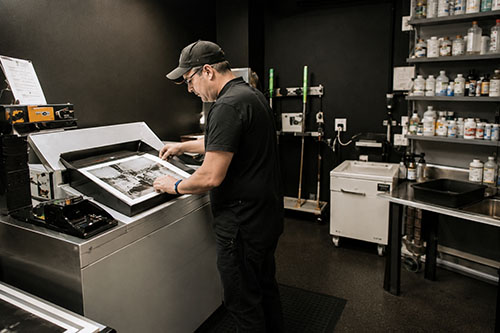
Carefully restored from historic photographic source material and professionally lab-developed, this museum-quality photograph is presented uncropped, preserving the complete image area contained in the source. The restoration recovers fine facial detail, the texture of Karloff’s Monster makeup and costume, Clive’s clothing, the rough rocky terrain, drifting smoke and the tonal separation between flame, figures and night sky while retaining the character of the original black-and-white photography. The finished photograph contains no AI-generated image content.
A powerful meeting of two central figures in one of cinema’s most influential horror films, this image offers a dramatic and immediately recognizable piece of Frankenstein history for the serious classic-horror collector.
Product Enquiry
Kodak Professional Endura Paper
Kodak Endura papers provide an incredible amount of detail and smooth transition of tones. Designed for the professional photographer in mind, looking for a more traditional photo print style, Kodak Endura provides an extended print life and color gamut almost at the level of a high end fine art paper print.
Archival Matte Paper
Archival Matte Paper, also known as Moab Lasal Photo Matte, is our house stock fine art paper and is an economical favorite for fine art reproductions and photo prints. It features a smooth surface, heavy weight (230 g, 9.5-mil), neutral white, matte paper engineered for accurate color reproduction that provides high contrast and high-resolution output. This paper is acid-free, making it the perfect choice for both photography & fine art reproductions.
Giclee William Turner Paper by Hahnemühle
The William Turner by Hahnemühle is one of the most popular papers used in the Giclee printing industry. This is a 310g natural white mould made natural line paper with 100% rag content making it highly archival. It has a slight coarse texture which gives photos and artwork an elegant look. These fine art paper prints (also known as Giclee) are ordered by galleries, individual artists and photographers. The papers and inks are not only archival but use some of the most accurate print technology for full color prints.
- Giclee prints use very expensive archival pigmented inks.
- Highest level of color gamut available in printing (12 color printing).
- Exceptional black & white printing.
- Fade resistant, pigmented inks which provide a superior color range compared to other types of inks. Widely preferred in fine art and photography circles.
- We ONLY use professional grade fine art and photo paper that resist yellowing and aging.
Framing
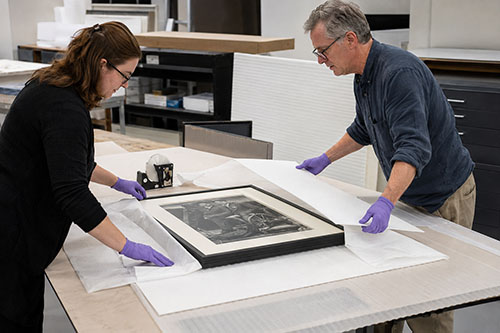
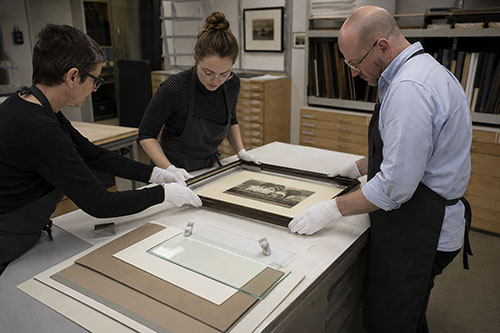
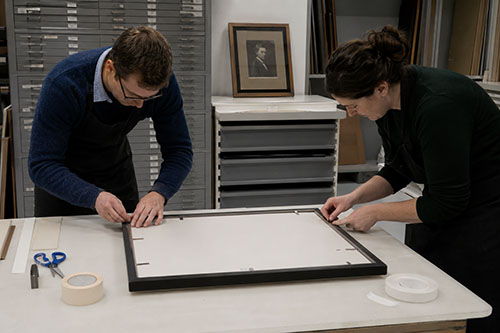
We offer wood and metal frames, custom cut & joined to order. Each framed print includes hanging hardware and foamcore backer.
Matting
We use conservation grade 100% virgin alpha-cellulose 2 ply mats with white core. Acid-free and lignin-free, these are both face resistant and meet all conservation quality standards set by the Fine Art Trade Guild. Mats are digitally cut for ultimate precision. The window will be 1/8″ smaller than the print dimensions.
Glazing (Acrylic Glass)
We offer custom cut panes of shatter-proof, acrylic glass, to protect your valuable artwork and prints.
Premium Clear
Framing grade clear acrylic is shatter resistant and lightweight.
Reflection Control
With its matte finish, Tru Vue Reflection Control® Acrylic scatters light to diminish unwanted glare.
Conservation Clear
Tru Vue Conservation Clear® Acrylic is a framing industry staple, blocking up to 99% of UV rays for ultimate protection.
Conservation Reflection Control
Tru Vue Conservation Reflection Control® Acrylic scatters and diffuses light to reduce unwanted glare. Blocks up to 99% of UV rays.
Related products
-

Susan Denberg – Frankenstein Created Woman (1967) Christina Hammer Glamour Publicity Portrait
$30.00 -
Sean Connery & Ursula Andress – Dr. No (1962) Relaxing Between Takes in Jamaica James Bond 007 Behind-the-Scenes Photo
$30.00 -
INGRID PITT, PETER CUSHING & DAWN ADDAMS – THE VAMPIRE LOVERS (1970) Savoy Hotel Seated Cast Press Photo
$30.00 -
BARBARA STEELE – THE HORRIBLE DR. HICHCOCK (1962) Cynthia Hichcock Skull Discovery Scene Photo
$38.00