

Clint Eastwood – Dirty Harry (1971) Harry Callahan Kezar Stadium Bleachers Publicity Photo
Limited Edition Photograph (learn more)
In stock
Clint Eastwood as Inspector Harry Callahan stands before the sweeping empty bleachers of San Francisco’s Kezar Stadium in this stark black-and-white publicity photograph from Dirty Harry (1971). Wearing Callahan’s textured sport coat over an open-collared shirt, Eastwood is isolated against the repeating stadium seats, his rigid stance and concentrated off-camera gaze giving the photograph the stripped-down intensity of the film’s celebrated Kezar Stadium confrontation.
The composition is unusually spare. Eastwood dominates the foreground, photographed from a low enough viewpoint that his torso rises strongly against the stadium background. His textured jacket, light shirt and dark trousers form a simple but immediately recognizable version of Harry Callahan’s plainclothes wardrobe. The open collar adds to the sense that the character has moved beyond routine police formality and into the physical pursuit that defines this portion of the film.
Behind him, the vast rows of empty seating create the image’s most distinctive visual element. The repeating horizontal lines of the bleachers extend across the frame and recede into soft focus, giving the photograph both depth and a feeling of isolation. With no crowd present, the stadium appears almost abstract—a huge public space temporarily emptied of ordinary life. Against that background, Callahan seems especially exposed, yet Eastwood’s upright posture and focused expression project control rather than vulnerability.
This Clint Eastwood Dirty Harry Kezar Stadium photo is closely associated with one of the film’s most memorable confrontations. After tracing Scorpio to quarters beneath the stadium grandstand, Callahan pursues him onto the field. The confrontation culminates with Callahan using his Smith & Wesson Model 29 .44 Magnum, wounding Scorpio and demanding information about the whereabouts of kidnapped teenager Ann Mary Deacon. Although the weapon itself is not visible in this particular crop, the stadium setting immediately connects the photograph with that pivotal sequence.
Produced and directed by Don Siegel for The Malpaso Company, Dirty Harry introduced Eastwood as San Francisco Police Inspector Harry Callahan, establishing a character whose controlled physical presence and uncompromising methods would become central to Eastwood’s screen identity. The film made extensive use of real San Francisco locations, and Kezar Stadium became one of its most recognizable environments. The enormous scale of the nearly deserted arena gives the confrontation an unusual visual character, replacing crowded city streets with open space, repeating architecture and a sense of stark isolation.
The original Kezar Stadium, located at the southeastern edge of Golden Gate Park, provided the production with a setting that could be both monumental and strangely desolate on screen. In the finished film, the empty grandstands emphasize the private nature of Callahan’s struggle with Scorpio, reducing the vast sports venue to a battleground between two men. That same quality is present here, where the stadium architecture surrounds Eastwood but never competes with him for visual attention.
For collectors of Clint Eastwood, Dirty Harry, Don Siegel and classic American crime cinema, the photograph offers a particularly strong location-based image. Rather than relying on gunplay or visible action, it captures the atmosphere of the Kezar sequence through Eastwood’s stance, wardrobe and the unmistakable backdrop of the empty bleachers.
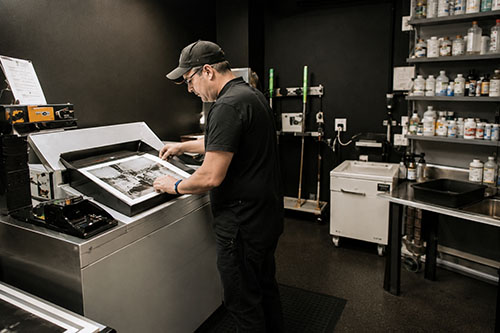
Carefully restored from historic photographic source material and professionally lab-developed, this museum-quality photograph is presented uncropped, preserving the complete image area contained in the source. Restoration recovers Eastwood’s facial and costume detail, jacket texture, shirt definition, stadium seating and the layered tonal separation of the empty bleachers while maintaining the natural tonal gradation and character of the historic black-and-white photograph. The finished photograph contains no AI-generated image content.
Product Enquiry
Kodak Professional Endura Paper
Kodak Endura papers provide an incredible amount of detail and smooth transition of tones. Designed for the professional photographer in mind, looking for a more traditional photo print style, Kodak Endura provides an extended print life and color gamut almost at the level of a high end fine art paper print.
Archival Matte Paper
Archival Matte Paper, also known as Moab Lasal Photo Matte, is our house stock fine art paper and is an economical favorite for fine art reproductions and photo prints. It features a smooth surface, heavy weight (230 g, 9.5-mil), neutral white, matte paper engineered for accurate color reproduction that provides high contrast and high-resolution output. This paper is acid-free, making it the perfect choice for both photography & fine art reproductions.
Giclee William Turner Paper by Hahnemühle
The William Turner by Hahnemühle is one of the most popular papers used in the Giclee printing industry. This is a 310g natural white mould made natural line paper with 100% rag content making it highly archival. It has a slight coarse texture which gives photos and artwork an elegant look. These fine art paper prints (also known as Giclee) are ordered by galleries, individual artists and photographers. The papers and inks are not only archival but use some of the most accurate print technology for full color prints.
- Giclee prints use very expensive archival pigmented inks.
- Highest level of color gamut available in printing (12 color printing).
- Exceptional black & white printing.
- Fade resistant, pigmented inks which provide a superior color range compared to other types of inks. Widely preferred in fine art and photography circles.
- We ONLY use professional grade fine art and photo paper that resist yellowing and aging.
Framing
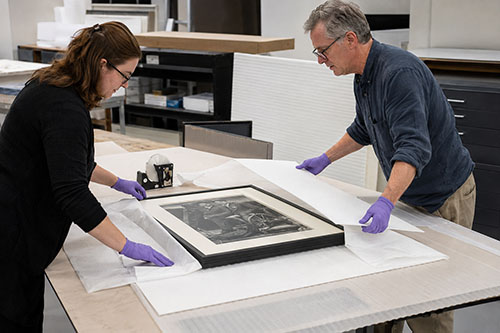
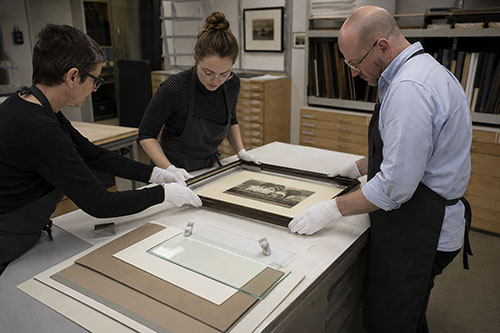
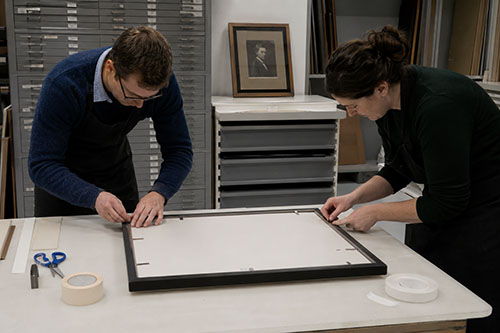
We offer wood and metal frames, custom cut & joined to order. Each framed print includes hanging hardware and foamcore backer.
Matting
We use conservation grade 100% virgin alpha-cellulose 2 ply mats with white core. Acid-free and lignin-free, these are both face resistant and meet all conservation quality standards set by the Fine Art Trade Guild. Mats are digitally cut for ultimate precision. The window will be 1/8″ smaller than the print dimensions.
Glazing (Acrylic Glass)
We offer custom cut panes of shatter-proof, acrylic glass, to protect your valuable artwork and prints.
Premium Clear
Framing grade clear acrylic is shatter resistant and lightweight.
Reflection Control
With its matte finish, Tru Vue Reflection Control® Acrylic scatters light to diminish unwanted glare.
Conservation Clear
Tru Vue Conservation Clear® Acrylic is a framing industry staple, blocking up to 99% of UV rays for ultimate protection.
Conservation Reflection Control
Tru Vue Conservation Reflection Control® Acrylic scatters and diffuses light to reduce unwanted glare. Blocks up to 99% of UV rays.
Related products
-

Clint Eastwood – Dirty Harry (1971) Panavision Camera Behind-the-Scenes Photo
$38.00 -
Klaus Kinski & Isabelle Adjani – Nosferatu the Vampyre (1979) Dracula & Lucy Bedside Scene Photo
$38.00 -
Peter Cushing – Torture Garden (1967) Lancelot Canning Poe Collector Close-Up Photo
$30.00 -
Peter Cushing & Susan Denberg – Frankenstein Created Woman (1967) Christina Bandage Experiment Publicity Photo
$30.00