

Dieter Eppler – Slaughter of the Vampires (1962) Vampire Impaled on Iron Gate Italian Gothic Horror Photo
Limited Edition Photograph (learn more)
In stock
Dieter Eppler appears as the Vampire at the moment of his violent destruction in this extraordinary black-and-white photograph from Slaughter of the Vampires (1962), photographed dramatically from below through the heavy bars of the wrought-iron gate. Eppler’s body appears trapped within the rigid geometry of the ironwork as his head falls backward in agony, his dark formal clothing merging with the surrounding shadows. The extreme low viewpoint and converging bars transform the architecture itself into a weapon, creating one of the film’s most visually distinctive images of Italian Gothic vampire horror.
The photograph is particularly powerful because the gate dominates almost as strongly as the Vampire. Thick vertical and horizontal bars divide the frame around Eppler’s body, while the upward camera angle exaggerates his expression and the violence of the moment. Rather than relying upon a conventional wooden stake, the film turns the castle’s own ironwork into the instrument of supernatural destruction.
Released in 1962 as La strage dei vampiri, the film was written and directed by Roberto Mauri and stars Dieter Eppler as the Vampire, Walter Brandi as Marquis Wolfgang, Graziella Granata as Louise and Luigi Batzella, credited as Paolo Solvay, as Dr. Nietzsche. Ugo Brunelli served as cinematographer, Aldo Piga composed the music and Jenner Menghi edited the production.
Set in nineteenth-century Austria, the story follows newlyweds Wolfgang and Louise after they move into a castle haunted by a mysterious vampire. Louise falls increasingly under the creature’s influence, while her declining health and disturbing behavior eventually lead Wolfgang to seek help. The story develops through seduction, supernatural possession and death before culminating in the confrontation represented by this photograph.
During the climax, Wolfgang corners the Vampire and drives him onto the pointed spikes of an iron grating, creating an unusually architectural variation on traditional vampire destruction. Reference summaries specifically identify the iron spikes as the means by which the Vampire is finally killed, making this photograph directly connected with one of the film’s most important narrative moments.
The production was filmed at Castle d’Aquino in Monte San Giovanni Campano, in Italy’s Frosinone province. The historic castle provided much of the film’s Gothic environment, and verified location research identifies it as the residence used for Marquis Wolfgang and the setting for the Vampire’s attacks.
Slaughter of the Vampires belongs to the wave of Italian Gothic horror that developed following films such as Mario Bava’s Black Sunday. Although made on a modest budget, it uses castles, aristocratic characters, nightmarish interiors and vampire mythology to create the atmospheric European horror style increasingly associated with Italian cinema during the early 1960s.
The film later circulated in the United States as Curse of the Blood Ghouls, along with other alternate titles, giving it a long afterlife among collectors of European vampire and cult horror cinema.
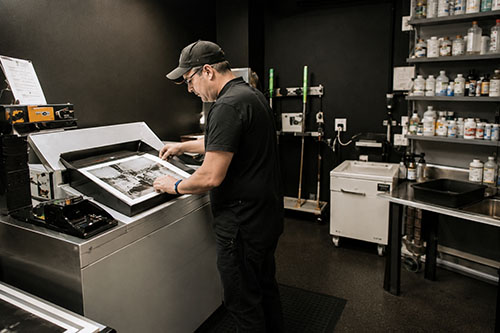
Carefully restored from historic photographic source material and professionally lab-developed, this museum-quality photograph is presented uncropped, preserving the complete image area contained in the source. Meticulous restoration recovers facial detail, ironwork texture, costume definition, architectural detail, tonal range and shadow separation while retaining the stark dramatic character of the original black-and-white image.
For collectors of Dieter Eppler, Slaughter of the Vampires and Italian Gothic horror, this is an exceptional climactic image—the Vampire impaled upon the iron gate, photographed from beneath the bars as architecture, violence and expression combine in one of the film’s most memorable moments.
Product Enquiry
Kodak Professional Endura Paper
Kodak Endura papers provide an incredible amount of detail and smooth transition of tones. Designed for the professional photographer in mind, looking for a more traditional photo print style, Kodak Endura provides an extended print life and color gamut almost at the level of a high end fine art paper print.
Archival Matte Paper
Archival Matte Paper, also known as Moab Lasal Photo Matte, is our house stock fine art paper and is an economical favorite for fine art reproductions and photo prints. It features a smooth surface, heavy weight (230 g, 9.5-mil), neutral white, matte paper engineered for accurate color reproduction that provides high contrast and high-resolution output. This paper is acid-free, making it the perfect choice for both photography & fine art reproductions.
Giclee William Turner Paper by Hahnemühle
The William Turner by Hahnemühle is one of the most popular papers used in the Giclee printing industry. This is a 310g natural white mould made natural line paper with 100% rag content making it highly archival. It has a slight coarse texture which gives photos and artwork an elegant look. These fine art paper prints (also known as Giclee) are ordered by galleries, individual artists and photographers. The papers and inks are not only archival but use some of the most accurate print technology for full color prints.
- Giclee prints use very expensive archival pigmented inks.
- Highest level of color gamut available in printing (12 color printing).
- Exceptional black & white printing.
- Fade resistant, pigmented inks which provide a superior color range compared to other types of inks. Widely preferred in fine art and photography circles.
- We ONLY use professional grade fine art and photo paper that resist yellowing and aging.
Framing
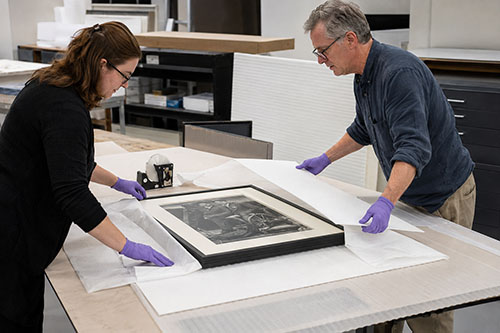
We offer wood and metal frames, custom cut & joined to order. Each framed print includes hanging hardware and foamcore backer.
Matting
We use conservation grade 100% virgin alpha-cellulose 2 ply mats with white core. Acid-free and lignin-free, these are both face resistant and meet all conservation quality standards set by the Fine Art Trade Guild. Mats are digitally cut for ultimate precision. The window will be 1/8″ smaller than the print dimensions.
Glazing (Acrylic Glass)
We offer custom cut panes of shatter-proof, acrylic glass, to protect your valuable artwork and prints.
Premium Clear
Framing grade clear acrylic is shatter resistant and lightweight.
Reflection Control
With its matte finish, Tru Vue Reflection Control® Acrylic scatters light to diminish unwanted glare.
Conservation Clear
Tru Vue Conservation Clear® Acrylic is a framing industry staple, blocking up to 99% of UV rays for ultimate protection.
Conservation Reflection Control
Tru Vue Conservation Reflection Control® Acrylic scatters and diffuses light to reduce unwanted glare. Blocks up to 99% of UV rays.
Related products
-

Sean Connery & Ursula Andress – Dr. No (1962) Between Takes in Jamaica James Bond 007 BTS Photo
$30.00 -
Barbara Steele – The Horrible Dr. Hichcock (1962) Coffin Confinement Scene Photo
$30.00 -
Sean Connery & Ursula Andress – Dr. No (1962) Crab Key Water Scene Jamaica Behind-the-Scenes Photo
$38.00 -
Klaus Kinski – Fitzcarraldo (1982) Brian Sweeney Fitzgerald Jungle Location Publicity Photo
$25.00