

Dieter Eppler – Slaughter of the Vampires (1962) Vampire Rising from Coffin Italian Gothic Horror Photo
Limited Edition Photograph (learn more)
In stock
Dieter Eppler appears as the Vampire rising from his coffin in this wonderfully atmospheric black-and-white photograph from Slaughter of the Vampires (1962). Sitting rigidly upright inside the narrow wooden coffin, Eppler is surrounded by rough masonry, heavy wine barrels and the massive coffin lid leaning across the foreground. His pale face, formal black clothing and stark white shirt emerge sharply from the cramped cellar surroundings, creating a beautifully claustrophobic image of the vampire awakening from his concealed resting place.
The photograph is especially effective because the environment feels almost too confined to contain him. The coffin occupies much of the frame, while barrels crowd the foreground and weathered stone presses in from behind. Rather than presenting the Vampire in a sweeping Gothic chamber, the composition traps him among practical cellar objects, making his supernatural presence feel strangely immediate and physical.
Released in 1962 under the Italian title La strage dei vampiri, the film was written and directed by Roberto Mauri. Dieter Eppler plays the unnamed Vampire, with Walter Brandi as Marquis Wolfgang, Graziella Granata as Louise and Luigi Batzella, credited as Paolo Solvay, as Dr. Nietzsche. Ugo Brunelli handled the cinematography, Aldo Piga composed the music and Dino Sant’Ambrogio produced.
The story follows newlyweds Wolfgang and Louise after they settle into a restored castle in nineteenth-century Austria. Unknown to them, a vampire has established his hiding place in the wine cellar, where his coffin remains concealed among the barrels. He emerges from this refuge to infiltrate the household and begins preying upon Louise, gradually drawing the couple into a nightmare of blood loss, supernatural influence and death.
That cellar setting gives this photograph particular narrative importance. It shows the Vampire not merely as an elegant intruder at the castle but within the hidden space from which he operates. The crude wooden coffin and utilitarian wine barrels contrast sharply with Eppler’s aristocratic black clothing, emphasizing the divide between his outwardly refined appearance and the secret predatory existence beneath it.
Eppler’s interpretation belongs to the tradition of the aristocratic European vampire, relying upon formal dress, pale features and commanding physical presence rather than elaborate monster makeup. His severe appearance and controlled movements fit naturally within the visual language of early-1960s Italian Gothic cinema, when filmmakers increasingly combined vampire mythology with decaying castles, shadow-filled interiors and heightened romantic atmosphere.
Slaughter of the Vampires emerged during the important expansion of Italian Gothic horror following the international success of films such as Mario Bava’s Black Sunday (1960). Although produced on a much smaller scale, Mauri’s film embraces many of the same visual traditions—ancient architecture, nocturnal menace, aristocratic victims, supernatural corruption and elaborate black-and-white photography.
The production was filmed at Castle d’Aquino in Monte San Giovanni Campano, which provided the historic architectural environment for Wolfgang’s residence and the Vampire’s attacks. The surviving location work contributes significantly to the film’s authentic Gothic character.
The film later circulated in the United States as Curse of the Blood Ghouls and under several additional international titles, giving it a long cult afterlife among collectors of European vampire cinema.
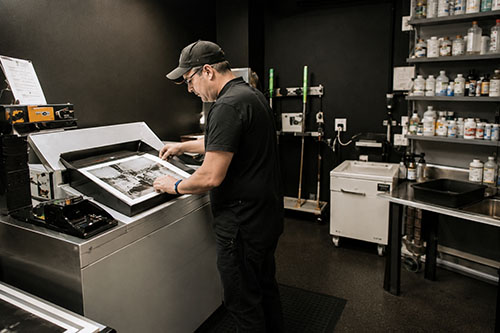
Carefully restored from historic photographic source material and professionally lab-developed, this museum-quality photograph is presented uncropped, preserving the complete image area contained in the source. Meticulous restoration recovers facial detail, coffin wood grain, barrel texture, stonework, costume definition, tonal range and shadow separation while retaining the claustrophobic atmosphere of the original black-and-white image.
For collectors of Dieter Eppler, Slaughter of the Vampires and Italian Gothic horror, this is an exceptional vampire image—Eppler rising upright from his coffin amid barrels and rough cellar masonry, preserving the secret resting place from which the film’s supernatural menace emerges.
Product Enquiry
Kodak Professional Endura Paper
Kodak Endura papers provide an incredible amount of detail and smooth transition of tones. Designed for the professional photographer in mind, looking for a more traditional photo print style, Kodak Endura provides an extended print life and color gamut almost at the level of a high end fine art paper print.
Archival Matte Paper
Archival Matte Paper, also known as Moab Lasal Photo Matte, is our house stock fine art paper and is an economical favorite for fine art reproductions and photo prints. It features a smooth surface, heavy weight (230 g, 9.5-mil), neutral white, matte paper engineered for accurate color reproduction that provides high contrast and high-resolution output. This paper is acid-free, making it the perfect choice for both photography & fine art reproductions.
Giclee William Turner Paper by Hahnemühle
The William Turner by Hahnemühle is one of the most popular papers used in the Giclee printing industry. This is a 310g natural white mould made natural line paper with 100% rag content making it highly archival. It has a slight coarse texture which gives photos and artwork an elegant look. These fine art paper prints (also known as Giclee) are ordered by galleries, individual artists and photographers. The papers and inks are not only archival but use some of the most accurate print technology for full color prints.
- Giclee prints use very expensive archival pigmented inks.
- Highest level of color gamut available in printing (12 color printing).
- Exceptional black & white printing.
- Fade resistant, pigmented inks which provide a superior color range compared to other types of inks. Widely preferred in fine art and photography circles.
- We ONLY use professional grade fine art and photo paper that resist yellowing and aging.
Framing
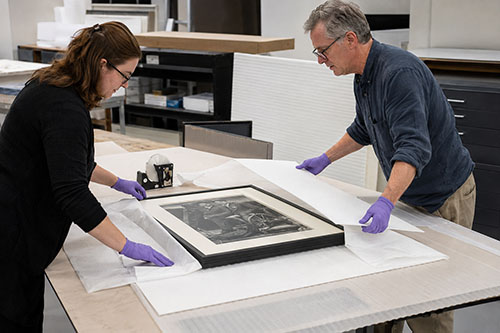
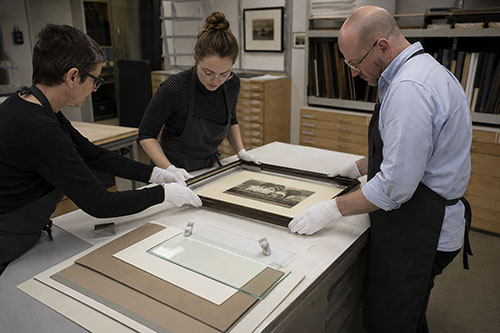
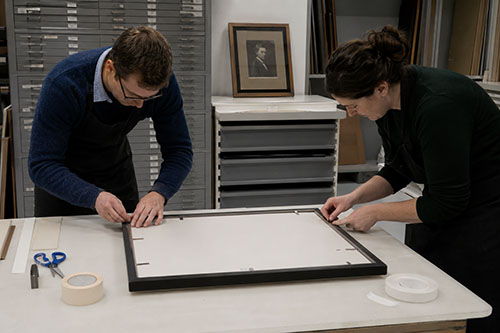
We offer wood and metal frames, custom cut & joined to order. Each framed print includes hanging hardware and foamcore backer.
Matting
We use conservation grade 100% virgin alpha-cellulose 2 ply mats with white core. Acid-free and lignin-free, these are both face resistant and meet all conservation quality standards set by the Fine Art Trade Guild. Mats are digitally cut for ultimate precision. The window will be 1/8″ smaller than the print dimensions.
Glazing (Acrylic Glass)
We offer custom cut panes of shatter-proof, acrylic glass, to protect your valuable artwork and prints.
Premium Clear
Framing grade clear acrylic is shatter resistant and lightweight.
Reflection Control
With its matte finish, Tru Vue Reflection Control® Acrylic scatters light to diminish unwanted glare.
Conservation Clear
Tru Vue Conservation Clear® Acrylic is a framing industry staple, blocking up to 99% of UV rays for ultimate protection.
Conservation Reflection Control
Tru Vue Conservation Reflection Control® Acrylic scatters and diffuses light to reduce unwanted glare. Blocks up to 99% of UV rays.
Related products
-

Ursula Andress – Dr. No (1962) Relaxing in Bikini on Jamaica Location Behind-the-Scenes Photo
$38.00 -
Sean Connery & Ursula Andress – Dr. No (1962) Crab Key Water Scene Jamaica Behind-the-Scenes Photo
$38.00 -
Colin Clive, Boris Karloff & Dwight Frye – Frankenstein (1931) Monster Creation Laboratory Wide View
$38.00 -
Yutte Stensgaard & Michael Johnson – Lust for a Vampire (1971) Mircalla & Richard Outdoor Embrace Photo
$38.00


