

Robert Picardo – The Howling (1981) Eddie Quist Werewolf Transformation Close-Up Photo
Limited Edition Photograph (learn more)
In stock
Robert Picardo is captured as Eddie Quist during his terrifying werewolf transformation in The Howling (1981), his human features visibly overtaken by the first unmistakable signs of lycanthropic change. The extreme color close-up reveals Eddie’s elongated fangs, unnaturally luminous eyes and distorted expression beneath the cold blue-green lighting of the sequence, creating an extraordinary study of a man suspended between recognizable human identity and the monstrous creature emerging from within him.
The photograph’s impact comes from the extraordinary proximity of the camera. Picardo’s face fills almost the entire composition, leaving virtually no background to distract from the transformation. His eyes appear enlarged and animalistic, reflecting points of light that give them an eerie supernatural intensity, while the newly emerged canine teeth dominate his open mouth. Damp, disordered hair and the dramatic shadow across one side of his face add to the sense that Eddie’s familiar appearance is physically breaking apart.
This Robert Picardo Eddie Quist The Howling 1981 photograph captures one of the elements that made the film’s transformation imagery so revolutionary. Rather than cutting quickly from human to completed monster, the sequence allows the audience to watch Eddie change through a progression of increasingly grotesque intermediate stages. The horror comes precisely from seeing that transition happen, preserving enough of Picardo’s human face to make each new alteration more disturbing.
Directed by Joe Dante, The Howling stars Dee Wallace as television reporter Karen White, whose traumatic encounter with Eddie Quist draws her into the mystery surrounding Dr. George Waggner’s secluded therapeutic community known as the Colony. Robert Picardo’s Eddie Quist initially appears as a dangerous human predator, but the revelation of his true nature transforms that threat into something explicitly supernatural.
The film’s celebrated transformation effects were created under Rob Bottin, whose practical makeup and mechanical effects became central to the picture’s reputation. Eddie’s metamorphosis was constructed as a series of physical stages involving prosthetic facial alterations, articulated effects, changing teeth and increasingly animalistic features. Instead of hiding the mechanics through darkness or rapid editing, the sequence confronts the viewer with the transformation at unusually close range.
This photograph is especially valuable because it isolates one of those intermediate stages. Eddie has not yet become the fully developed werewolf seen later in the film, but he is no longer conventionally human either. The altered eyes and extended fangs create a particularly effective visual threshold, while Picardo’s expression retains enough personality to keep the transformation emotionally connected to the character beneath the makeup.
The cold blue-green illumination gives the image another distinctive quality. Highlights strike Picardo’s forehead, eyes, cheekbones and teeth while deeper shadow models the rest of the face, allowing the prosthetic work and physical performance to register with remarkable clarity. The lighting does not soften the makeup; instead, it emphasizes the unnatural texture and changing structure of Eddie’s features.
Released in 1981, The Howling became one of the defining films of the modern werewolf revival, combining Joe Dante’s dark humor and suspense with Bottin’s elaborate practical-effects work. Alongside films such as An American Werewolf in London, it helped establish transformation itself as a major cinematic event rather than simply a transition between human and monster.
For collectors of 1980s horror and practical-effects photography, this close-up is particularly compelling because it concentrates on the precise instant when Eddie Quist becomes visibly inhuman. The glowing eyes, emerging fangs, distorted expression and extreme framing preserve Rob Bottin’s werewolf transformation work at the point where actor and creature are still visibly fused together.
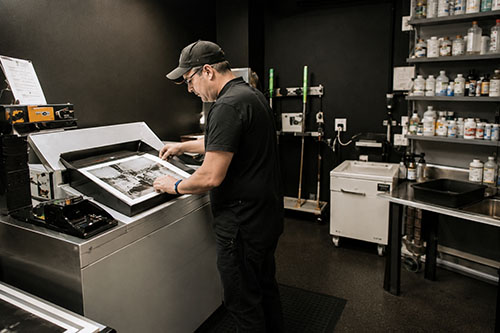
Carefully restored from historic photographic source material and professionally lab-developed, this museum-quality photograph is presented uncropped, preserving the complete image area contained in the source. Restoration recovers eye definition, fang detail, facial texture, individual hair strands and subtle blue-green shadow gradation while maintaining the natural color balance and authentic character of the historic photograph. The finished photograph contains no AI-generated image content.
Product Enquiry
Kodak Professional Endura Paper
Kodak Endura papers provide an incredible amount of detail and smooth transition of tones. Designed for the professional photographer in mind, looking for a more traditional photo print style, Kodak Endura provides an extended print life and color gamut almost at the level of a high end fine art paper print.
Archival Matte Paper
Archival Matte Paper, also known as Moab Lasal Photo Matte, is our house stock fine art paper and is an economical favorite for fine art reproductions and photo prints. It features a smooth surface, heavy weight (230 g, 9.5-mil), neutral white, matte paper engineered for accurate color reproduction that provides high contrast and high-resolution output. This paper is acid-free, making it the perfect choice for both photography & fine art reproductions.
Giclee William Turner Paper by Hahnemühle
The William Turner by Hahnemühle is one of the most popular papers used in the Giclee printing industry. This is a 310g natural white mould made natural line paper with 100% rag content making it highly archival. It has a slight coarse texture which gives photos and artwork an elegant look. These fine art paper prints (also known as Giclee) are ordered by galleries, individual artists and photographers. The papers and inks are not only archival but use some of the most accurate print technology for full color prints.
- Giclee prints use very expensive archival pigmented inks.
- Highest level of color gamut available in printing (12 color printing).
- Exceptional black & white printing.
- Fade resistant, pigmented inks which provide a superior color range compared to other types of inks. Widely preferred in fine art and photography circles.
- We ONLY use professional grade fine art and photo paper that resist yellowing and aging.
Framing
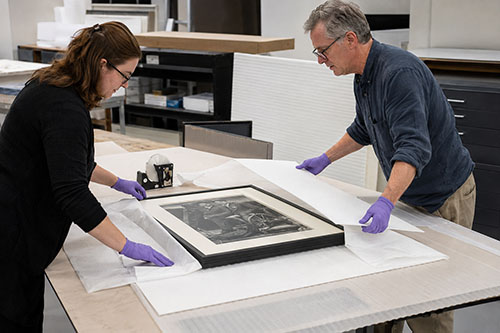
We offer wood and metal frames, custom cut & joined to order. Each framed print includes hanging hardware and foamcore backer.
Matting
We use conservation grade 100% virgin alpha-cellulose 2 ply mats with white core. Acid-free and lignin-free, these are both face resistant and meet all conservation quality standards set by the Fine Art Trade Guild. Mats are digitally cut for ultimate precision. The window will be 1/8″ smaller than the print dimensions.
Glazing (Acrylic Glass)
We offer custom cut panes of shatter-proof, acrylic glass, to protect your valuable artwork and prints.
Premium Clear
Framing grade clear acrylic is shatter resistant and lightweight.
Reflection Control
With its matte finish, Tru Vue Reflection Control® Acrylic scatters light to diminish unwanted glare.
Conservation Clear
Tru Vue Conservation Clear® Acrylic is a framing industry staple, blocking up to 99% of UV rays for ultimate protection.
Conservation Reflection Control
Tru Vue Conservation Reflection Control® Acrylic scatters and diffuses light to reduce unwanted glare. Blocks up to 99% of UV rays.
Related products
-

Madeline Smith – Frankenstein and the Monster from Hell (1974) Sarah Color Publicity Photo
$25.00 -
Terence Young & Ursula Andress – Dr. No (1962) Director Briefing James Bond 007 BTS Photo
$38.00 -
Barbara Steele – Black Sunday (1960) Katia Vajda Reclining on Bed Gothic Interior Photo
$38.00 -
Katya Wyeth & Damien Thomas – Twins of Evil (1971) Mircalla Vampire Bite Photo
$30.00


