

Peter Cushing & Susan Denberg – Frankenstein Created Woman (1967) Christina on Laboratory Table Publicity Photo
Limited Edition Photograph (learn more)
In stock
Peter Cushing as Baron Frankenstein works over Susan Denberg’s Christina in this striking color publicity photograph for Frankenstein Created Woman (1967). Christina lies across the laboratory table beneath a large surgical reflector while the black-gloved Baron leans forward, his direct gaze toward the camera making the carefully arranged composition feel unusually confrontational. The laboratory apparatus, exposed bandaging and Cushing’s clinical posture give the photograph a distinctive identity within Hammer’s Frankenstein publicity campaign.
The image is constructed around the strong contrast between Frankenstein’s deliberate control and Christina’s complete physical vulnerability. Cushing is positioned almost directly above her, dressed in a white shirt, dark waistcoat and patterned neckwear, with his sleeves rolled back for work. His black surgical gloves stand out sharply against Christina’s skin and the pale material covering her lower body. Susan Denberg lies face down across the padded table, her long blonde hair falling over the bright red headrest while the upper portion of her back remains exposed beneath a strip of medical dressing.
A large circular surgical reflector hangs prominently above the pair, immediately identifying the setting as one of Frankenstein’s improvised medical environments. Its metallic surface and articulated support dominate the upper portion of the photograph, while shelves, equipment and dark laboratory furnishings recede into the background. The warm interior colors, red table covering and natural flesh tones distinguish this Frankenstein Created Woman 1967 publicity photo from the stark black-and-white imagery often associated with earlier Frankenstein films.
Directed by Terence Fisher for Hammer Film Productions, Frankenstein Created Woman takes the series into unusual territory by shifting the Baron’s experiments away from the straightforward construction of a physical creature. Frankenstein has developed a method for isolating and preserving the human soul, believing that it can survive independently of the body and eventually be transferred into another human form. This more metaphysical approach gives the film a distinctive place within Hammer’s Frankenstein cycle.
Christina, played by Susan Denberg, is the daughter of an innkeeper and the lover of Hans, portrayed by Robert Morris. After tragedy overtakes both characters, Frankenstein restores Christina’s body and transfers Hans’s soul into her. The experiment dramatically transforms Christina, but the consequences soon move far beyond the Baron’s purely scientific intentions. Peter Cushing’s Frankenstein remains characteristically detached, treating death, resurrection and the transfer of identity as problems to be solved rather than moral boundaries to be respected.
The photograph captures that clinical detachment particularly well. Cushing does not appear distressed or hurried; instead, he looks directly outward with an expression of severe concentration while remaining physically positioned over Christina. The angle of his body, the surgical gloves and the suspended reflector create the impression of an operation temporarily interrupted for the camera. Denberg’s placement across the table provides the opposing visual element, her horizontal figure contrasting with Cushing’s upright posture and giving the publicity image a carefully balanced composition.
The film also featured Thorley Walters as Doctor Hertz, Frankenstein’s loyal associate, and continued the long-running collaboration between Peter Cushing and Terence Fisher that had helped establish Hammer’s distinctive approach to Gothic horror. Made during the later years of Hammer’s celebrated Bray Studios period, Frankenstein Created Woman combines traditional laboratory imagery with questions of identity, resurrection, revenge and the survival of consciousness after death.
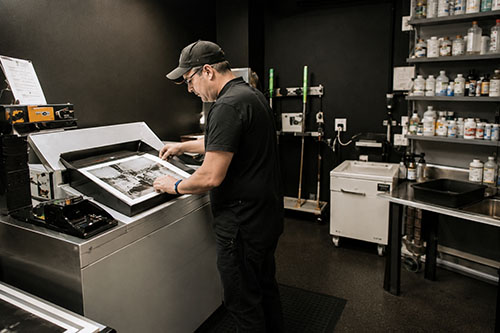
Carefully restored from historic photographic source material and professionally lab-developed, this museum-quality photograph is presented uncropped, preserving the complete image area contained in the source. Restoration recovers Cushing’s facial detail, Denberg’s blonde hair, surgical glove and bandage detail, the metallic reflector, laboratory surroundings and rich red table covering while maintaining the natural color balance and authentic character of the historic photograph. The finished photograph contains no AI-generated image content.
Product Enquiry
Kodak Professional Endura Paper
Kodak Endura papers provide an incredible amount of detail and smooth transition of tones. Designed for the professional photographer in mind, looking for a more traditional photo print style, Kodak Endura provides an extended print life and color gamut almost at the level of a high end fine art paper print.
Archival Matte Paper
Archival Matte Paper, also known as Moab Lasal Photo Matte, is our house stock fine art paper and is an economical favorite for fine art reproductions and photo prints. It features a smooth surface, heavy weight (230 g, 9.5-mil), neutral white, matte paper engineered for accurate color reproduction that provides high contrast and high-resolution output. This paper is acid-free, making it the perfect choice for both photography & fine art reproductions.
Giclee William Turner Paper by Hahnemühle
The William Turner by Hahnemühle is one of the most popular papers used in the Giclee printing industry. This is a 310g natural white mould made natural line paper with 100% rag content making it highly archival. It has a slight coarse texture which gives photos and artwork an elegant look. These fine art paper prints (also known as Giclee) are ordered by galleries, individual artists and photographers. The papers and inks are not only archival but use some of the most accurate print technology for full color prints.
- Giclee prints use very expensive archival pigmented inks.
- Highest level of color gamut available in printing (12 color printing).
- Exceptional black & white printing.
- Fade resistant, pigmented inks which provide a superior color range compared to other types of inks. Widely preferred in fine art and photography circles.
- We ONLY use professional grade fine art and photo paper that resist yellowing and aging.
Framing
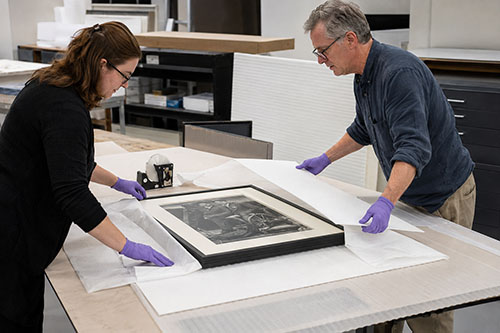
We offer wood and metal frames, custom cut & joined to order. Each framed print includes hanging hardware and foamcore backer.
Matting
We use conservation grade 100% virgin alpha-cellulose 2 ply mats with white core. Acid-free and lignin-free, these are both face resistant and meet all conservation quality standards set by the Fine Art Trade Guild. Mats are digitally cut for ultimate precision. The window will be 1/8″ smaller than the print dimensions.
Glazing (Acrylic Glass)
We offer custom cut panes of shatter-proof, acrylic glass, to protect your valuable artwork and prints.
Premium Clear
Framing grade clear acrylic is shatter resistant and lightweight.
Reflection Control
With its matte finish, Tru Vue Reflection Control® Acrylic scatters light to diminish unwanted glare.
Conservation Clear
Tru Vue Conservation Clear® Acrylic is a framing industry staple, blocking up to 99% of UV rays for ultimate protection.
Conservation Reflection Control
Tru Vue Conservation Reflection Control® Acrylic scatters and diffuses light to reduce unwanted glare. Blocks up to 99% of UV rays.
Related products
-

Ingrid Pitt – Countess Dracula (1971) Countess Elisabeth Nádasdy Laughing in Costume Hammer Gothic Horror Photo
$38.00 -
Martine Beswick – Thunderball (1965) Paula Caplan 007 Bond Girl Tiger-Stripe Swimsuit Bahamas Publicity Photo
$30.00 -
Clint Eastwood – Dirty Harry (1971) Seated Candid on Sidewalk Behind-the-Scenes Photo
$38.00 -
Clint Eastwood & Don Siegel – Dirty Harry (1971) Rooftop Behind-the-Scenes Photo
$38.00


