

Roman Polanski & Shelley Winters – The Tenant (1976) Trelkovsky & Concierge Doorway Behind-the-Scenes Photo
Limited Edition Photograph (learn more)
In stock
Roman Polanski and Shelley Winters are captured amid the working production crew of The Tenant (1976) in this exceptional black-and-white behind-the-scenes photograph. Polanski, in costume as Trelkovsky, stands immediately behind Winters as the Concierge within a narrow doorway while a tightly packed group of technicians works below them. The railings, crew members, equipment and confined architectural space crowd virtually every part of the frame, creating a wonderfully revealing image in which performance and filmmaking activity occupy the same physical environment.
The photograph is particularly compelling because it shows how little separation existed between actors, technicians and set during the creation of the film’s claustrophobic interiors. Polanski and Winters remain positioned in the doorway while crew personnel crouch and gather immediately beneath them, apparently preparing or adjusting the shot. Rather than presenting a polished production portrait, the image preserves the practical congestion and coordination required to photograph a scene inside The Tenant’s deliberately oppressive apartment building.
Released in 1976, The Tenant was directed by Roman Polanski, who also portrays Trelkovsky, the nervous new resident whose growing suspicion of his neighbors develops into psychological disintegration. Shelley Winters plays the building’s Concierge, one of the first residents Trelkovsky encounters when he investigates the apartment previously occupied by Simone Choule. Paramount and AFI both confirm these character assignments.
The film also stars Isabelle Adjani as Stella, Melvyn Douglas as Monsieur Zy, Jo Van Fleet as Madame Dioz, Bernard Fresson and Lila Kedrova. Sven Nykvist served as director of photography, bringing his internationally celebrated control of light and interior space to Polanski’s increasingly hallucinatory psychological world.
The architecture of the building was fundamental to the production. Polanski later explained that although portions of the film were photographed on the streets of Paris, he also had an extensive five-story apartment-building set constructed at the Épinay studios, extending from the Concierge’s lodge through the apartments so that he could control the environment precisely. Production designer Pierre Guffroy, with art directors Claude Moesching and Albert Rajau, shaped the elaborate interiors that became central to the film’s oppressive atmosphere.
That information gives this doorway photograph particular production value. The Concierge’s lodge and surrounding architecture were not simply incidental backgrounds; they belonged to a carefully controlled environment in which doorways, corridors, windows and stairways repeatedly restrict Trelkovsky’s movement and reinforce his growing sense of surveillance. The clustered crew seen here reveals the physical craftsmanship hidden immediately outside the finished frame.
Shelley Winters’ Concierge is an important part of that environment. Abrasive and suspicious from Trelkovsky’s first arrival, she helps establish the uncomfortable social atmosphere of the building before his paranoia becomes overwhelming. Winters brings a forceful physical presence to the role, making the Concierge one of the memorable personalities surrounding Polanski’s increasingly isolated tenant.
Polanski and Gérard Brach adapted the screenplay from Roland Topor’s novel Le Locataire chimérique. The story follows Trelkovsky after he rents an apartment whose former occupant attempted suicide, gradually convincing himself that the residents of the building intend to transform him into the dead woman. The apartment and its inhabitants therefore become inseparable from the film’s themes of paranoia, identity and psychological collapse.
The Tenant is frequently grouped with Repulsion (1965) and Rosemary’s Baby (1968) as Polanski’s informal Apartment Trilogy, films in which domestic spaces become increasingly threatening expressions of psychological fear. In The Tenant, that relationship between character and architecture is especially intense, making behind-the-scenes photographs of the sets and their working environments particularly revealing.
For collectors interested in Roman Polanski, Shelley Winters and motion-picture production history, this photograph offers considerably more than a conventional cast image. It shows two principal performers surrounded by the technicians required to create the scene, exposing the close physical relationship between acting, camera preparation and production design inside the carefully constructed apartment environment.
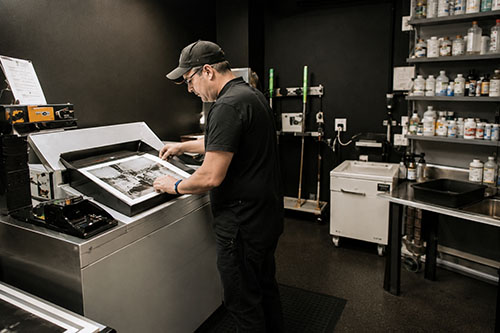
Carefully restored from historic photographic source material and professionally lab-developed, this museum-quality photograph is presented uncropped, preserving the complete image area contained in the source. Meticulous restoration recovers facial detail, clothing texture, architectural definition, crew detail, tonal range and photographic clarity while retaining the documentary character of the original black-and-white behind-the-scenes production photograph.
For collectors of Roman Polanski, Shelley Winters, The Tenant and 1970s psychological cinema, this is an exceptional production image—Trelkovsky and the Concierge positioned together in the doorway while technicians crowd the working space immediately below them, preserving an unusually intimate record of actors, crew and architecture coming together during the making of one of the era’s most distinctive psychological films.
Product Enquiry
Kodak Professional Endura Paper
Kodak Endura papers provide an incredible amount of detail and smooth transition of tones. Designed for the professional photographer in mind, looking for a more traditional photo print style, Kodak Endura provides an extended print life and color gamut almost at the level of a high end fine art paper print.
Archival Matte Paper
Archival Matte Paper, also known as Moab Lasal Photo Matte, is our house stock fine art paper and is an economical favorite for fine art reproductions and photo prints. It features a smooth surface, heavy weight (230 g, 9.5-mil), neutral white, matte paper engineered for accurate color reproduction that provides high contrast and high-resolution output. This paper is acid-free, making it the perfect choice for both photography & fine art reproductions.
Giclee William Turner Paper by Hahnemühle
The William Turner by Hahnemühle is one of the most popular papers used in the Giclee printing industry. This is a 310g natural white mould made natural line paper with 100% rag content making it highly archival. It has a slight coarse texture which gives photos and artwork an elegant look. These fine art paper prints (also known as Giclee) are ordered by galleries, individual artists and photographers. The papers and inks are not only archival but use some of the most accurate print technology for full color prints.
- Giclee prints use very expensive archival pigmented inks.
- Highest level of color gamut available in printing (12 color printing).
- Exceptional black & white printing.
- Fade resistant, pigmented inks which provide a superior color range compared to other types of inks. Widely preferred in fine art and photography circles.
- We ONLY use professional grade fine art and photo paper that resist yellowing and aging.
Framing
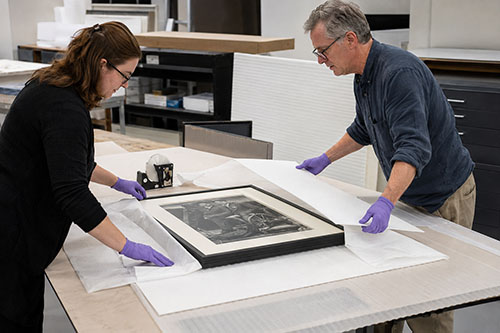
We offer wood and metal frames, custom cut & joined to order. Each framed print includes hanging hardware and foamcore backer.
Matting
We use conservation grade 100% virgin alpha-cellulose 2 ply mats with white core. Acid-free and lignin-free, these are both face resistant and meet all conservation quality standards set by the Fine Art Trade Guild. Mats are digitally cut for ultimate precision. The window will be 1/8″ smaller than the print dimensions.
Glazing (Acrylic Glass)
We offer custom cut panes of shatter-proof, acrylic glass, to protect your valuable artwork and prints.
Premium Clear
Framing grade clear acrylic is shatter resistant and lightweight.
Reflection Control
With its matte finish, Tru Vue Reflection Control® Acrylic scatters light to diminish unwanted glare.
Conservation Clear
Tru Vue Conservation Clear® Acrylic is a framing industry staple, blocking up to 99% of UV rays for ultimate protection.
Conservation Reflection Control
Tru Vue Conservation Reflection Control® Acrylic scatters and diffuses light to reduce unwanted glare. Blocks up to 99% of UV rays.
Related products
-

Sean Connery & Ursula Andress – Dr. No (1962) Crab Key Water Scene Jamaica Behind-the-Scenes Photo
$38.00 -
Ingrid Pitt, Peter Cushing & Dawn Addams – The Vampire Lovers (1970) Savoy Hotel Seated Cast Press Photo
$30.00 -
Yutte Stensgaard & Michael Johnson – Lust for a Vampire (1971) Mircalla & Richard Outdoor Embrace Photo
$38.00 -
Sean Connery & Ursula Andress – Dr. No (1962) Connery Brushing Hair on Beach Behind-the-Scenes Photo
$38.00


