

Roman Polanski & Sven Nykvist – The Tenant (1976) On-Location Camera Setup Behind-the-Scenes Photo
Limited Edition Photograph (learn more)
In stock
Roman Polanski and cinematographer Sven Nykvist are captured at work during location filming of The Tenant (1976) in this exceptional black-and-white behind-the-scenes production photograph. Polanski bends directly into the motion-picture camera to inspect the composition through its viewfinder while Nykvist stands immediately behind him, watching the setup amid a dense gathering of crew members and onlookers. The prominent camera body, eyepiece and surrounding street activity give the image an unusually immediate documentary quality, preserving a revealing moment of director and cinematographer shaping a shot together.
The photograph is especially valuable because it places the filmmaking process itself at the center of the image. Rather than showing Polanski directing from a distance, he is physically engaged with the camera, checking precisely what the lens will record. Nykvist’s position directly behind him emphasizes the close visual collaboration between director and cinematographer, while the crowded location environment illustrates the practical complexity of creating carefully controlled images outside the studio.
Released in 1976, The Tenant was directed by Roman Polanski, who also portrays the central character Trelkovsky. The cast includes Isabelle Adjani as Stella, Melvyn Douglas, Jo Van Fleet, Shelley Winters, Bernard Fresson and Lila Kedrova. Sven Nykvist served as director of photography, with the American Film Institute confirming him as the film’s cinematographer.
The screenplay by Roman Polanski and Gérard Brach was adapted from Roland Topor’s novel Le Locataire chimérique. The story follows Trelkovsky, a withdrawn man who rents a Paris apartment after its previous occupant attempts suicide. As his obsession with the former tenant grows, his perception of the apartment, his neighbors and ultimately his own identity becomes increasingly unstable.
For Sven Nykvist, The Tenant brought his internationally celebrated approach to cinematography into Polanski’s psychologically claustrophobic world. Best known for his long collaboration with Ingmar Bergman, Nykvist was renowned for expressive natural light, restrained camera movement and subtle tonal control. BFI specifically notes how his elegant camera movements contribute to the film’s hallucinatory atmosphere.
The production was photographed using Panavision equipment, a technical detail confirmed by the American Film Institute. Principal photography ran from 14 November 1975 into mid-March 1976, placing this photograph within a clearly documented production period.
AFI production credits identify Jean Harnois as camera operator, with François Catonne and Bruno De Keyser serving as camera assistants and Bernard Prim as still photographer. These credits reveal the larger technical team working under Nykvist to translate Polanski’s demanding compositions into the finished film.
The image is particularly interesting in the context of Polanski’s working method. By looking personally through the camera, the director could evaluate framing and spatial relationships from exactly the position of the lens. With Nykvist beside him, the photograph preserves the point where direction, cinematography and physical camera placement intersect, making it an especially compelling document for collectors interested in filmmaking technique.
The Tenant is frequently grouped with Repulsion (1965) and Rosemary’s Baby (1968) as Polanski’s informal Apartment Trilogy, three films in which enclosed urban spaces become inseparable from paranoia, isolation and psychological deterioration. In The Tenant, Nykvist’s cinematography and Pierre Guffroy’s production design give those themes an unusually controlled and disturbing visual form.
For collectors of Roman Polanski, Sven Nykvist and motion-picture production history, this photograph offers considerably more than a conventional promotional image. The visible camera, crowded location and close physical interaction between director and cinematographer preserve filmmaking as an active process rather than hiding the machinery behind the finished illusion.
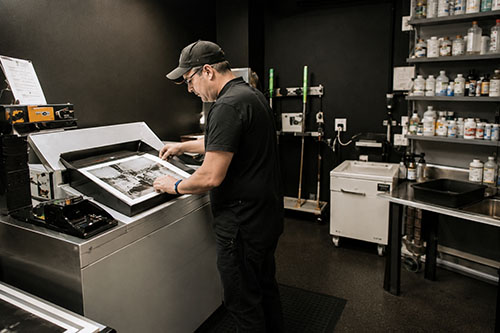
Carefully restored from historic photographic source material and professionally lab-developed, this museum-quality photograph is presented uncropped, preserving the complete image area contained in the source. Meticulous restoration recovers facial detail, camera-equipment definition, clothing texture, street detail, tonal range and photographic clarity while retaining the documentary character of the original black-and-white behind-the-scenes photograph.
For collectors of Roman Polanski, Sven Nykvist, The Tenant and classic cinematography, this is an exceptional production image—Polanski inspecting the shot directly through the motion-picture camera while Nykvist watches immediately behind him, preserving a rare and unusually intimate record of director and cinematographer at work during the making of one of the defining psychological films of the 1970s.
Product Enquiry
Kodak Professional Endura Paper
Kodak Endura papers provide an incredible amount of detail and smooth transition of tones. Designed for the professional photographer in mind, looking for a more traditional photo print style, Kodak Endura provides an extended print life and color gamut almost at the level of a high end fine art paper print.
Archival Matte Paper
Archival Matte Paper, also known as Moab Lasal Photo Matte, is our house stock fine art paper and is an economical favorite for fine art reproductions and photo prints. It features a smooth surface, heavy weight (230 g, 9.5-mil), neutral white, matte paper engineered for accurate color reproduction that provides high contrast and high-resolution output. This paper is acid-free, making it the perfect choice for both photography & fine art reproductions.
Giclee William Turner Paper by Hahnemühle
The William Turner by Hahnemühle is one of the most popular papers used in the Giclee printing industry. This is a 310g natural white mould made natural line paper with 100% rag content making it highly archival. It has a slight coarse texture which gives photos and artwork an elegant look. These fine art paper prints (also known as Giclee) are ordered by galleries, individual artists and photographers. The papers and inks are not only archival but use some of the most accurate print technology for full color prints.
- Giclee prints use very expensive archival pigmented inks.
- Highest level of color gamut available in printing (12 color printing).
- Exceptional black & white printing.
- Fade resistant, pigmented inks which provide a superior color range compared to other types of inks. Widely preferred in fine art and photography circles.
- We ONLY use professional grade fine art and photo paper that resist yellowing and aging.
Framing
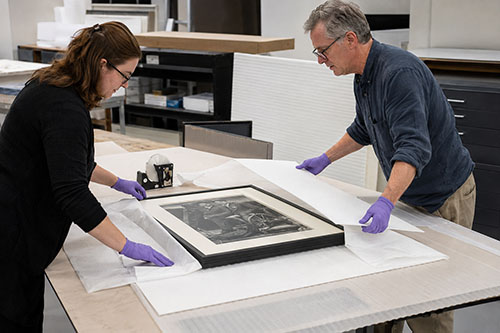
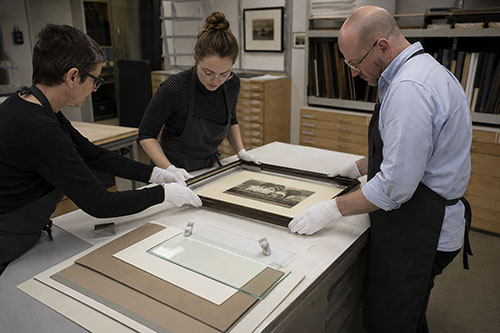
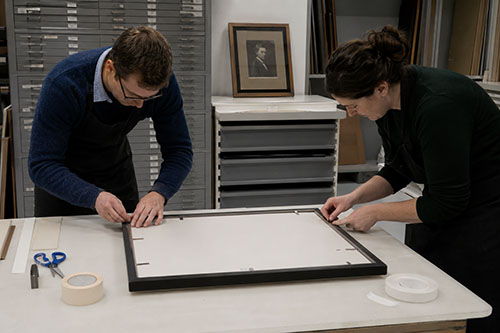
We offer wood and metal frames, custom cut & joined to order. Each framed print includes hanging hardware and foamcore backer.
Matting
We use conservation grade 100% virgin alpha-cellulose 2 ply mats with white core. Acid-free and lignin-free, these are both face resistant and meet all conservation quality standards set by the Fine Art Trade Guild. Mats are digitally cut for ultimate precision. The window will be 1/8″ smaller than the print dimensions.
Glazing (Acrylic Glass)
We offer custom cut panes of shatter-proof, acrylic glass, to protect your valuable artwork and prints.
Premium Clear
Framing grade clear acrylic is shatter resistant and lightweight.
Reflection Control
With its matte finish, Tru Vue Reflection Control® Acrylic scatters light to diminish unwanted glare.
Conservation Clear
Tru Vue Conservation Clear® Acrylic is a framing industry staple, blocking up to 99% of UV rays for ultimate protection.
Conservation Reflection Control
Tru Vue Conservation Reflection Control® Acrylic scatters and diffuses light to reduce unwanted glare. Blocks up to 99% of UV rays.
Related products
-

Catherine Deneuve – Repulsion (1965) Carol Ledoux Apartment Floor Camera BTS Photo
$30.00 -
Ingrid Pitt, Peter Cushing & Dawn Addams – The Vampire Lovers (1970) Savoy Hotel Seated Cast Press Photo
$30.00 -
Sean Connery & Ursula Andress – Dr. No (1962) Connery Brushing Hair on Beach Behind-the-Scenes Photo
$38.00 -
Boris Karloff & Colin Clive – Frankenstein (1931) Monster & Creator Torch Confrontation Universal Horror Photo
$38.00


